
Strong Arms & Cardio Workout: Sculpt Your Upper Body and Boost Endurance
Ready to power up your physique and supercharge your stamina? This “Strong Arms & Cardio Workout” is expertly designed to challenge your upper body muscles while simultaneously elevating your heart rate, delivering a comprehensive fitness experience. Part of our popular Summer Sweat Series, this routine is perfect for anyone looking to build impressive arm strength, enhance shoulder definition, and improve overall cardiovascular health. Whether you’re working out at home or in the gym, these effective dumbbell exercises will help you achieve a lean, toned, and powerful upper body while burning calories and boosting your endurance.
Combining targeted strength training with dynamic movements, this workout ensures every major muscle group in your arms, shoulders, and chest gets the attention it deserves. By performing these exercises in a circuit, you’ll keep your metabolism firing and your heart pumping, making every minute count towards your fitness goals. Get ready to transform your upper body and feel incredibly strong!
Essential Equipment for Your Workout
To maximize the effectiveness of this powerful upper body and cardio circuit, you’ll need a selection of dumbbells. We recommend having:
- Light Dumbbells: Ideal for warm-ups, lighter movements, and ensuring perfect form.
- Medium Dumbbells: Your go-to for most of the core exercises, offering a balance of challenge and control.
- Heavy Dumbbells: For those exercises where you want to push your limits and build significant strength, or for advanced modifications.
Having a range allows you to progressively overload your muscles and adapt the workout to your current strength level. Remember, choosing the right weight is crucial for both effectiveness and injury prevention. You should feel challenged by the last few repetitions, but still be able to maintain proper form.
Prepare Your Body: The Importance of a Warm-Up
Before diving into any intense workout, a proper warm-up is non-negotiable. It prepares your muscles and cardiovascular system for the demands ahead, reducing the risk of injury and improving your performance. For this “Strong Arms & Cardio Workout,” we recommend:
Warm Up: A 20-minute light run
A light run gently elevates your heart rate, increases blood flow to your muscles, and warms up your joints. If running isn’t an option, consider alternatives like:
- Brisk walking or jogging in place
- Cycling on a stationary bike
- Dynamic stretches such as arm circles, leg swings, torso twists, and jumping jacks
Aim to feel a slight sweat and increased mobility before you begin the main circuit. This crucial preparatory phase ensures your body is primed for optimal performance and ready to conquer every repetition.
Workout Structure: Maximize Your Gains
This workout is structured as a circuit to keep your heart rate elevated and your muscles engaged. You will perform each exercise for a set number of repetitions, complete multiple sets, and take strategic rest periods to allow for recovery and sustained intensity.
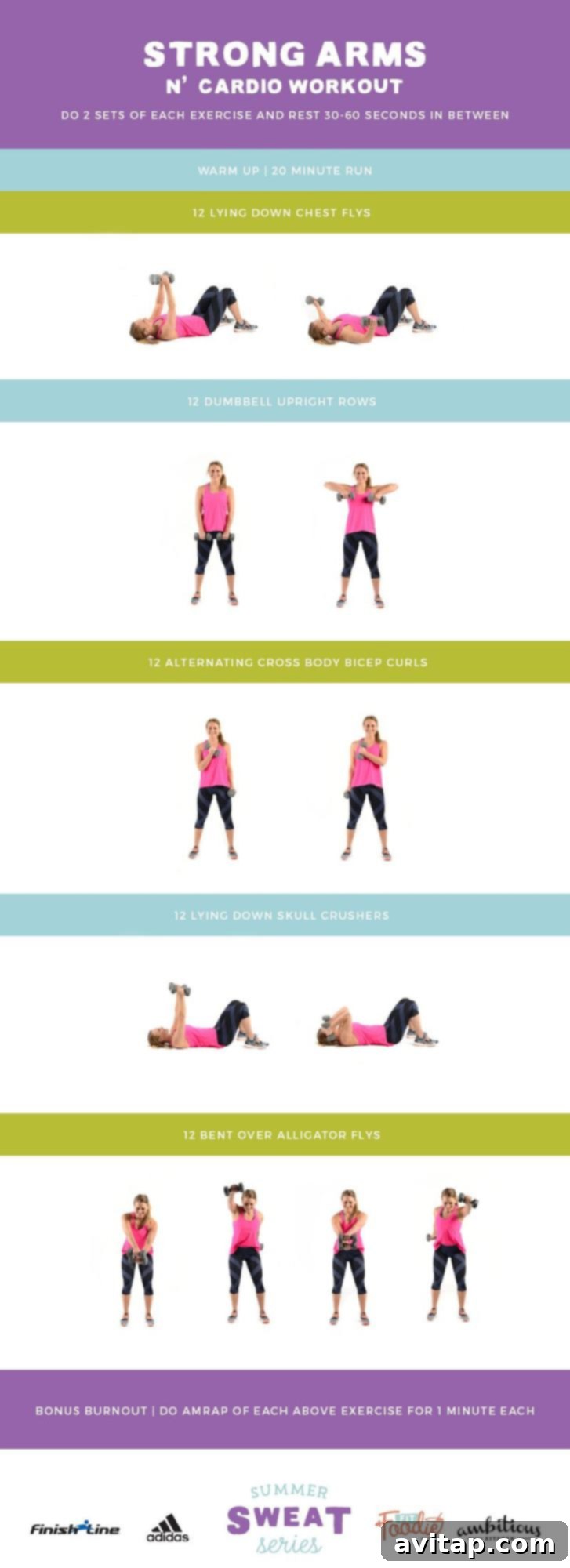
Description: Perform 2 sets of each exercise within the circuit. After completing all repetitions for a given exercise, rest for 30-60 seconds before moving on to the next exercise. Once you’ve completed one set of all five exercises, take a slightly longer rest (1-2 minutes) before starting your second round of the entire circuit.
This approach helps build muscular endurance, enhances cardiovascular fitness, and keeps your workout efficient and exciting. Focus on controlled movements and maintaining excellent form throughout.
The Strong Arms & Cardio Circuit
Get ready to activate your muscles and build serious upper body strength with these powerful dumbbell exercises. Each movement is designed to target specific muscle groups, contributing to a well-rounded and defined physique.
1. Lying Down Chest Flys (12 Reps)
The Lying Down Chest Fly is a fantastic isolation exercise for targeting your pectoral muscles, promoting chest width and definition. It also engages your anterior deltoids, contributing to overall shoulder health and aesthetics.
- Begin by lying flat on your back on a sturdy bench or the floor. Ensure your head, back, and hips are firmly supported.
- Hold a dumbbell in each hand, extending your arms straight up towards the ceiling, palms facing each other. Keep a slight, soft arch in your elbows – avoid locking them completely. This is your starting position.
- Slowly lower the dumbbells out to the sides in a wide arc, as if you’re hugging a large tree. Maintain that slight bend in your elbows throughout the movement. You should feel a stretch across your chest as the dumbbells reach about shoulder level, or slightly below if comfortable.
- Engage your chest muscles to bring the dumbbells back up towards the starting position, squeezing them together at the top, just shy of touching. Focus on using your chest to pull the weight, rather than your biceps or momentum.
- Pause briefly at the top to enhance the muscle contraction, then slowly and controlled lower them back down.
- Repeat for 12 controlled repetitions.
Key Form Cues: Keep your core engaged to stabilize your lower back. Control both the lowering and lifting phases to maximize muscle engagement. Avoid letting the dumbbells drop too low, which can strain your shoulders. Breathe in as you lower the weights, and exhale as you bring them up.
2. Dumbbell Upright Row (12 Reps)
The Dumbbell Upright Row is an excellent exercise for building strong, broad shoulders and well-defined traps. It primarily targets the lateral deltoids and traps, contributing to that coveted V-taper look and improving posture.
- Stand tall with your feet shoulder-width apart, holding a dumbbell in each hand with an overhand (pronated) grip, palms facing your body. The dumbbells should be resting lightly against your thighs. Your arms should be extended with a slight bend at the elbows, and your back should be straight and core engaged. This is your solid starting position.
- As you exhale, use your side shoulders (lateral deltoids) to lift the dumbbells straight up towards your chin. Keep the dumbbells close to your body throughout the upward movement. The key is to drive the motion with your elbows, ensuring they are always higher than your forearms.
- Continue lifting until the dumbbells are just below your chin, or until your elbows reach shoulder height. Avoid shrugging your shoulders excessively.
- Pause momentarily at the top of the movement, squeezing your shoulder blades together. Maintain a stationary torso to isolate the shoulder muscles.
- Slowly and with control, lower the dumbbells back down to the starting position along the same path as you inhale.
- Complete 12 repetitions, focusing on a smooth and controlled movement without swinging the weights.
Key Form Cues: Prevent your elbows from flaring out too wide. Keep your core tight to avoid rocking your body. If you feel any shoulder discomfort, reduce the weight or opt for an alternative shoulder exercise. The movement should be deliberate, not rushed.
3. Alternating Cross Body Bicep Curls (12 Reps per Arm)
The Alternating Cross Body Bicep Curl offers a unique way to target the biceps, providing an excellent peak contraction and improving arm symmetry. This variation emphasizes bicep isolation and control.
- Stand upright with a dumbbell in each hand, arms extended downwards at your sides, and palms facing inwards (a neutral grip). Maintain a slight bend in your knees and keep your core gently braced.
- Keeping your right palm facing inward and without twisting your arm, curl the dumbbell from your right hand upwards and across your body towards your left shoulder. Exhale as you perform the curl.
- Focus on squeezing your bicep at the top of the movement, touching the top of the dumbbell to your left shoulder if possible, and holding the contraction for a second.
- Slowly and with complete control, lower the dumbbell along the same cross-body path back to the starting position as you inhale. Avoid letting gravity take over.
- Immediately repeat the same movement with your left arm, curling the dumbbell towards your right shoulder.
- Continue alternating between arms until you have completed 12 repetitions for each arm (a total of 24 curls).
Key Form Cues: The key here is to minimize momentum. Keep your elbows relatively stable and tucked close to your body. Focus on the bicep doing the work. Don’t arch your back; keep your torso stable. A controlled eccentric (lowering) phase is just as important as the concentric (lifting) phase for muscle growth.
4. Lying Down Skull Crushers (12 Reps)
Skull Crushers are a classic triceps exercise, renowned for building impressive arm size and strength in the posterior part of your upper arm. This exercise specifically targets all three heads of the triceps brachii.
- Lie on a flat bench with your feet firmly planted on the floor, holding two dumbbells directly above your chest. Your arms should be fully extended, forming a 90-degree angle from your torso and parallel to the floor. Position the dumbbells so your palms are facing each other, and keep your elbows tucked in, not flaring out. This is your starting position.
- Keeping your upper arms stationary and your elbows tucked, slowly lower the dumbbells by bending only at your elbows. Allow the dumbbells to descend until they are close to your ears or just above your forehead. Inhale during this lowering phase.
- Once the dumbbells reach the lowest point, engage your triceps to extend your arms, pushing the dumbbells back up to the starting position. Focus on a strong contraction of the triceps as you exhale.
- Ensure that only your forearms are moving; your upper arms should remain perpendicular to the floor throughout the entire movement.
- Repeat for 12 controlled and powerful repetitions.
Key Form Cues: Avoid letting your elbows flare out during the movement, as this can reduce triceps engagement and place strain on your elbows. Don’t use your chest or shoulders to assist the lift. If you feel excessive pressure on your elbows, try using slightly lighter dumbbells. Maintain constant tension on the triceps.
5. Bentover Alligator Flys (12 Reps)
The Bentover Alligator Fly is a unique and effective exercise for targeting the often-neglected muscles of the upper back and rear shoulders (posterior deltoids, rhomboids, and traps). This movement is excellent for improving posture, shoulder health, and preventing imbalances.
- Stand with your feet shoulder-width apart, holding a light to medium dumbbell in each hand. Slightly bend your knees and hinge forward at your hip joint, keeping your back perfectly flat and your core tight. Your torso should be nearly parallel to the floor, and your arms should hang straight down from your shoulders, palms facing each other. This is your starting position.
- Maintaining a slight bend in your elbows (imagine you’re holding a large beach ball), lift both arms out to the sides in a wide arc. Focus on squeezing your shoulder blades together powerfully at the top of the movement, as if trying to pinch a pencil between them. Your arms should reach about shoulder height, forming a “T” shape with your torso.
- Hold the contraction for a brief moment, really feeling the squeeze in your upper back and rear shoulders.
- With control, slowly lower the dumbbells back down towards the ground, resisting gravity. Avoid letting the weights just drop; the controlled descent is crucial for muscle engagement.
- This completes one repetition. Complete 12 deliberate repetitions.
Key Form Cues: The most critical aspect is maintaining a flat back throughout the exercise to protect your spine. If you find your back rounding, either lighten the weights or don’t hinge as deeply. Avoid shrugging your shoulders towards your ears. Focus on the squeeze between your shoulder blades rather than just lifting the weights with your arms.
Bonus Burnout: Push Your Limits!
To really ignite your metabolism, build endurance, and give your muscles one final push, add this bonus burnout round. It’s designed to challenge your stamina and leave you feeling accomplished!
- Perform an AMRAP (As Many Rounds As Possible) for each of the five exercises listed above. You will dedicate 1 minute to each exercise, aiming to complete as many repetitions as you can with good form within that minute.
- Move directly from one exercise to the next with minimal rest (e.g., 10-15 seconds for transition only) until you’ve completed all five exercises.
- This intense burst will significantly elevate your heart rate, maximize calorie burn, and push your muscular endurance to its limits. Listen to your body, but challenge yourself!
Cool Down: Essential for Recovery and Flexibility
After such an intense workout, don’t skip the cool-down phase! It’s just as important as the warm-up for promoting recovery, improving flexibility, and preventing muscle soreness.
- Spend 5-10 minutes performing static stretches, holding each stretch for 20-30 seconds.
- Focus on stretching the muscles you just worked: chest, shoulders, biceps, triceps, and upper back.
- Examples include overhead triceps stretch, bicep stretch against a wall, chest stretch in a doorway, and shoulder stretches.
- Slow down your breathing, lower your heart rate, and give your body a chance to transition out of the workout mode.
Incorporating a proper cool-down will leave you feeling refreshed and ready for your next workout session.
Disclaimer: Always consult your doctor or a qualified healthcare professional before starting any new fitness regime, especially if you have pre-existing health conditions or concerns. While the Summer Sweat Series exercise program was designed in collaboration with a professional trainer (Lee from Fit Foodie Finds and Monique from Ambitious Kitchen), you are participating in this workout at your own risk. It is crucial to listen to your body, understand its limits, and modify exercises as needed to prevent injury. If you experience any pain or discomfort, stop immediately. Your health and safety are paramount.