

Torch Calories & Build Strength: The Ultimate Full-Body HIIT Workout
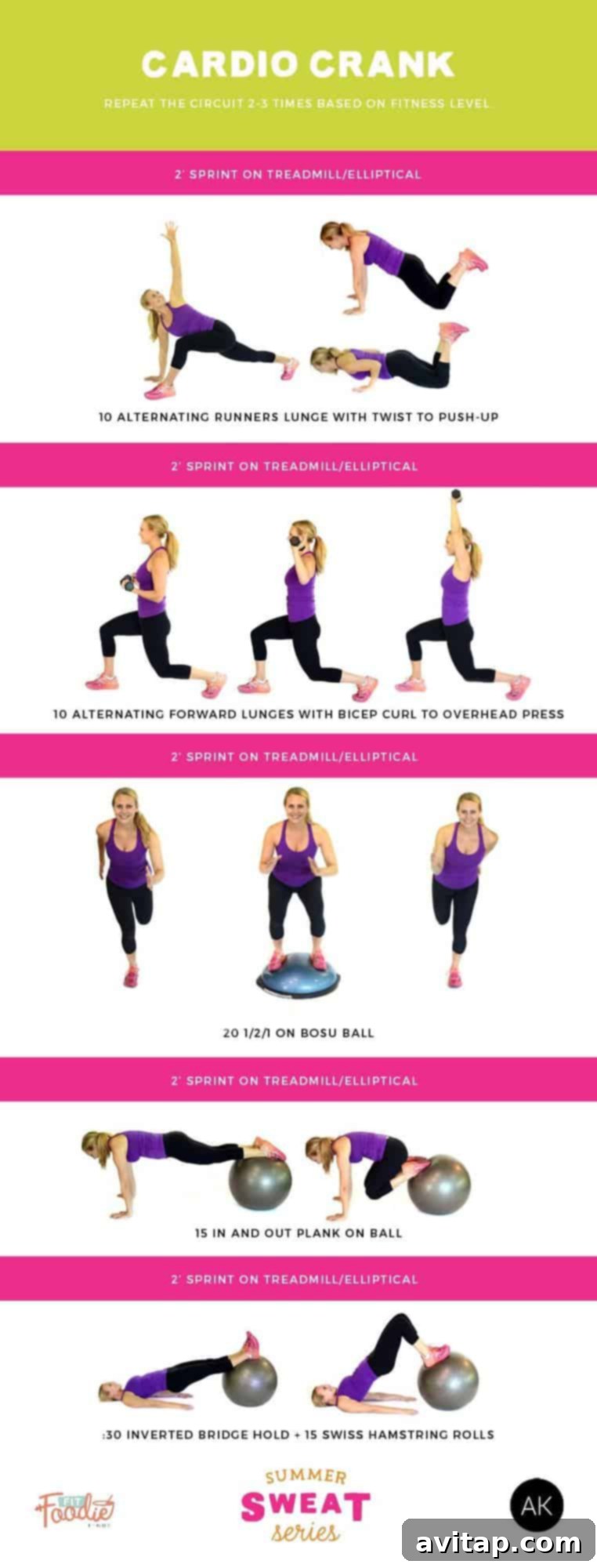
Are you ready to redefine your fitness routine and unlock your full potential? This dynamic workout is expertly designed to maximize calorie burn, boost your metabolism, and sculpt a stronger, more resilient physique. By seamlessly blending high-intensity sprint intervals with powerful full-body strength exercises, you’ll engage every major muscle group while significantly enhancing your cardiovascular endurance. Get ready to challenge yourself, push your limits, and achieve incredible results!
Why This Full-Body HIIT Workout Delivers Results
Combining the best elements of cardio and strength training into a single, cohesive routine offers unparalleled benefits for both your body and mind. High-Intensity Interval Training (HIIT), characterized by short bursts of intense effort followed by brief recovery periods, is a proven method for torching calories long after your workout ends – a phenomenon known as the “afterburn effect” or EPOC (Excess Post-exercise Oxygen Consumption). This means your body continues to burn calories at an elevated rate even when you’re resting. Paired with full-body strength exercises, you’re not just burning fat; you’re also building lean muscle mass, which further boosts your resting metabolism.
Key Benefits You’ll Experience:
- Maximum Calorie Burn: The alternating sprints and strength exercises keep your heart rate elevated, leading to significant caloric expenditure throughout and after your session.
- Improved Cardiovascular Health: Regular sprint intervals strengthen your heart and lungs, enhancing overall endurance, stamina, and efficiency.
- Increased Muscle Strength & Definition: Targeting all major muscle groups helps build functional strength, improves posture, and contributes to a more toned and athletic physique.
- Metabolism Boost: Building lean muscle mass and engaging in HIIT training both contribute to a higher resting metabolic rate, aiding in sustainable weight management and fat loss.
- Enhanced Agility & Coordination: Exercises involving the Bosu ball and varied movements improve balance, proprioception, and quickness, translating to better performance in daily activities and other sports.
- Time-Efficient: This workout is incredibly effective, allowing you to achieve comprehensive fitness benefits in a shorter amount of time compared to traditional steady-state cardio or isolated strength training.
Essential Equipment for Your Workout
To perform this circuit effectively and safely, you’ll need a few key pieces of equipment. These tools are specifically chosen to amplify the challenge and provide comprehensive full-body engagement, making your workout more dynamic and impactful.
- Medium-Size Weights: Opt for dumbbells that challenge you without compromising proper form. They’ll be used for lunges, bicep curls, and overhead presses, adding resistance to build strength and muscle endurance.
- Bosu Ball: This versatile piece of equipment (a half-sphere on a flat platform) is excellent for improving balance, stability, and engaging deep core muscles. It introduces an element of instability that makes exercises more challenging and effective, enhancing proprioception.
- Physio Ball (Stability Ball): Also known as a Swiss ball, this large inflatable ball is crucial for advanced core work, stability exercises, and hamstring conditioning, providing both support and a dynamic challenge for various muscle groups.
- Treadmill or Elliptical: Essential for the high-intensity sprint intervals, allowing you to control your speed and resistance to maximize cardiovascular effort and push your limits safely.
Description: Complete the entire circuit 2-3 times depending on your current fitness level and available time. Aim for a quick transition between exercises to keep your heart rate elevated and maximize the benefits of continuous effort.
The Ultimate Calorie-Torching Circuit
This workout is structured as a circuit, strategically alternating between dynamic cardio sprints and compound strength exercises. Remember to focus on proper form for each movement to prevent injury and ensure maximum effectiveness from every repetition.
Warm-Up (5-10 minutes)
Before diving into the main circuit, prepare your body with a light warm-up. This crucial step increases blood flow to your muscles, improves flexibility, and significantly reduces the risk of injury. A good warm-up could include:
- Light jogging or marching in place (2-3 minutes)
- Dynamic stretches such as arm circles, leg swings, torso twists, and hip rotations (1-2 minutes)
- Bodyweight movements like air squats, lunges without weights, and cat-cow stretches (2-3 minutes)
Phase 1: High-Intensity Sprint
2 Minute Sprint on Treadmill or Elliptical
Engage in a two-minute sprint on your chosen cardio machine. Push yourself to an RPE (Rate of Perceived Exertion) of 8-9 out of 10. This should feel challenging, leaving you breathless but able to maintain good form. If on a treadmill, increase your speed significantly. If on an elliptical, increase both speed and resistance. The goal here is to spike your heart rate and ignite your metabolism, setting the stage for the strength portion of the circuit.
Exercise A: Alternating Runner’s Lunge with Twist to Push-Up
10 Total Reps (5 per side)
This compound exercise is a fantastic full-body mover, targeting your core, legs, glutes, chest, and shoulders. It seamlessly combines strength with mobility and a touch of cardiovascular engagement.
- Starting Position: Begin in a strong high plank pose, ensuring your hands are directly under your shoulders and your body forms a straight line from head to heels. Engage your core tightly.
- Runner’s Lunge: Step your left leg forward into a wide runner’s lunge, planting your foot firmly to the outside of your left hand. Keep your left knee stacked over your ankle and your right leg straight and active behind you.
- Torso Twist: While keeping your right hand planted firmly next to your left foot, raise your left arm straight up towards the ceiling, opening your chest and twisting your torso. Feel the stretch in your hip and rotation in your spine. Hold this position briefly to enhance flexibility.
- Return to Plank & Push-Up: Bring your left hand back down to the floor. Step your left foot back to meet your right, returning to the high plank position. From here, immediately perform one push-up. For modification, you can drop to your knees, ensuring your body stays in a straight line from head to knees.
- Alternate Sides: Push back up from the push-up. Repeat the entire sequence on the other side, stepping your right leg forward for the lunge.
Form Focus: Maintain deep core engagement throughout the movement, control the transition, and keep your hips stable during the twist. This movement builds explosive power, improves hip mobility, and strengthens your upper body and core simultaneously, making it highly functional.
Phase 2: High-Intensity Sprint
2 Minute Sprint on Treadmill or Elliptical
Just like before, push your pace and intensity. These sprints are crucial for continuous cardiovascular conditioning and keeping that metabolic furnace burning strong. Focus on maintaining strong, powerful strides or rotations, even as fatigue begins to set in. This is where mental toughness and consistency truly come into play.
Exercise B: Alternating Forward Lunges with Bicep Curl to Overhead Press
10 Total Reps (5 per side)
This dynamic tri-set exercise efficiently targets your legs, glutes, biceps, and shoulders, delivering a comprehensive strength challenge with each repetition. Grab your medium-size weights for this one.
- Starting Position: Stand tall with your feet hip-width distance apart, holding a dumbbell in each hand. Your palms should face forward, and arms extended by your sides.
- Forward Lunge & Bicep Curl: Step forward with your right leg into a 90/90 lunge (front knee stacked over ankle, back knee hovering above the ground, both knees bent at 90 degrees). Simultaneously, perform a bicep curl, bringing the dumbbells up towards your shoulders. Keep your chest lifted and shoulders pulled back.
- Isometric Lunge Hold & Overhead Press: While maintaining the 90/90 lunge position (this is the “isometric hold”), smoothly transition into an overhead press. Tee your arms out to the sides (elbows bent at 90 degrees, dumbbells at shoulder height) and press the weights directly overhead until your arms are fully extended.
- Return & Reset: Lower the weights back to shoulder height with control, then bring them back to your sides as you step your right leg back to the starting standing position.
- Alternate Sides: Repeat the entire sequence, stepping forward with your left leg.
Form Focus: Control the weights throughout the entire movement. Keep your core tight to protect your back, and ensure your knees track directly over your toes during the lunge. This exercise builds significant lower body strength, challenges stability, and develops upper body pushing and pulling power, all in one fluid motion.
Phase 3: High-Intensity Sprint
2 Minute Sprint on Treadmill or Elliptical
You’re halfway through the sprint intervals! Dig deep and maintain your intensity. Remember the immense benefits of these short bursts: enhanced fat burning, improved endurance, and a powerful metabolism. Push your limits safely, always focusing on good form even at maximum speed.
Exercise C: 20 1/2/1 on Bosu (Agility & Balance Challenge)
20 Total Reps (10 per side)
This dynamic Bosu ball exercise is a fantastic way to improve your agility, quick feet, balance, and single-leg strength. It’s designed to be fast-paced, challenging, and highly engaging for your core stabilizers.
- Starting Position: Place the Bosu ball to your right side, dome-side up. Begin in a low, athletic stance with a slight bend in your knees, standing to the left of the Bosu.
- Leap and Land (Right): From your left leg, powerfully leap off the ground and quickly step your right foot onto the top of the Bosu, then immediately step your left foot off the Bosu, landing on the right-hand side of the Bosu with your right foot. You should land softly on your right foot, absorbing the impact, and immediately dropping into a low, single-leg squat position.
- Hold and Stabilize: Hold this single-leg squat on the Bosu for 2 seconds, focusing intensely on stability and engaging your core and glutes to maintain perfect balance.
- Return and Repeat (Left): Push off your right foot from the Bosu, leaping back across to the left side. Quickly step your left foot onto the Bosu, then immediately step your right foot off the Bosu, landing on the left-hand side of the Bosu with your left foot. Drop into a low single-leg squat and hold for 2 seconds.
Counting: One full sequence (landing and holding on the right side, then landing and holding on the left side) counts as one complete round. Aim for 10 such rounds, totaling 20 “1/2/1” actions (10 per side). The “1/2/1” refers to the quick touch on the Bosu, then stepping off and landing.
Form Focus: Emphasize quick transitions and soft, controlled landings to protect your joints and maximize agility benefits. This exercise truly tests your proprioception, fast-twitch muscle fibers, and coordination. For a visual demonstration, you can watch an example here.
Phase 4: High-Intensity Sprint
2 Minute Sprint on Treadmill or Elliptical
The penultimate sprint! Give it your absolute all. Visualize your fitness goals and push through any discomfort you might feel. This is the point where your body adapts, grows stronger, and your endurance significantly improves. Maintain that explosive power and high effort level to maximize the caloric burn and cardiovascular benefit.
Exercise D: In and Out Plank on Physio Ball (Advanced Core Stability)
15 Reps
This advanced plank variation is excellent for challenging your core stability, lower abdominal strength, and hip flexors, all while introducing an element of dynamic instability from the physio ball. It requires immense control and core engagement.
- Starting Position: Begin in a high plank position on the floor, but with your shins (just above your ankles) resting on top of a physio ball. Your hands should be directly under your shoulders, fingers spread wide, and your body should form a straight line from your head to your heels, hovering above the floor. Engage your glutes and core deeply to prevent your hips from sagging.
- Knee Tuck (In): Keeping your core extremely tight and controlled, slowly pull your knees in towards your chest by rolling the physio ball closer to your hands. Your hips will naturally rise slightly, but avoid rounding your lower back excessively.
- Extension (Out): With controlled movement, extend your legs back out, rolling the physio ball away from you until you return to the starting high plank position. Maintain that strong, straight line, resisting the urge to let your hips drop.
Form Focus: The key here is to keep your shoulders stacked directly over your wrists and your core deeply engaged throughout the entire movement. Avoid letting your hips sag or pike too high unless it’s part of the controlled knee tuck. This exercise is fantastic for building a rock-solid core, improving overall body control, and enhancing stability.
Phase 5: High-Intensity Sprint
2 Minute Sprint on Treadmill or Elliptical
This is it – your final sprint interval for this circuit! Empty the tank and leave nothing behind. Maximize your speed and intensity for these last two minutes. Finish strong, knowing you’ve pushed your cardiovascular limits and are building incredible endurance and metabolic efficiency. Give it your maximum effort!
Exercise E: Inverted Bridge Hold + Swiss Hamstring Rolls
30 Second Hold + 15 Rolls
This powerful duo effectively targets your hamstrings, glutes, and core, significantly improving strength, stability, and posterior chain activation. The physio ball adds an excellent element of challenge and instability.
- Inverted Bridge Hold (30 Seconds): Lie on your back on the floor with your legs extended and your calves (just above your ankles) resting on top of the physio ball. Actively lift your hips off the floor, engaging your glutes and hamstrings, until your body forms one long, straight line from your shoulders to your knees. Your core should be engaged, and avoid overarching your lower back. Hold this challenging position for 30 seconds, maintaining continuous stability.
- Swiss Hamstring Rolls (15 Reps): From the inverted bridge hold position, and while keeping your hips continuously elevated, inhale and slowly roll the physio ball towards your body by bending your knees. As you roll, your hips will naturally lift even higher towards the ceiling, further engaging your hamstrings and glutes intensely.
- Extension: On the exhale, slowly extend your legs back out, rolling the ball away from you until you return to the starting inverted bridge hold position (calves on ball, hips elevated). Ensure the movement is controlled and smooth, preventing the ball from wobbling or your hips from dropping.
Form Focus: Maintain continuous tension in your hamstrings and glutes throughout both the hold and the rolls. Avoid letting your hips drop during the movement. This exercise is exceptional for strengthening the posterior chain, which is crucial for athletic performance, injury prevention, and overall functional strength.
Cool-Down & Recovery (Post-Circuit)
After completing your final circuit round, dedicate 5-10 minutes to a proper cool-down. This essential phase helps to gradually bring your heart rate down, improve flexibility, and aid in muscle recovery, reducing post-workout soreness. Focus on static stretches, holding each stretch for 20-30 seconds.
- Hamstring stretch (seated or standing)
- Quad stretch (standing)
- Calf stretch (against a wall)
- Chest stretch (using a doorway or physio ball)
- Triceps stretch
- Gentle spinal twists and hip flexor stretches
Important Considerations for Your Workout Success
Stay Hydrated and Fuel Your Body
Proper hydration before, during, and after your workout is paramount for optimal performance and recovery. Drink plenty of water throughout the day. Additionally, fuel your body with nutrient-rich foods to support your energy levels and aid in muscle repair and growth. A balanced diet rich in lean protein, complex carbohydrates, and healthy fats will optimize your results and help you recover faster.
Listen to Your Body & Modify
Every individual’s fitness journey is unique. It’s crucial to listen to your body and adjust the workout as needed. If an exercise feels too challenging, opt for a modification (e.g., knee push-ups, lighter weights, slower pace). If you feel sharp pain, stop immediately. Conversely, if you find the exercises too easy, increase your weights, extend your hold times, or add an extra circuit round to further challenge yourself.
Consistency is Key
Remember that significant results come from consistency and dedication, not just intense one-off sessions. Aim to incorporate this workout into your routine 2-3 times per week, allowing for adequate rest days in between to facilitate muscle recovery and growth. Over time, you’ll undoubtedly notice significant improvements in your strength, endurance, and overall fitness level.
Unleash Your Potential
This full-body HIIT and strength circuit is more than just a workout; it’s a powerful tool to transform your physical capabilities and boost your overall well-being. By embracing the challenge of high-intensity sprint intervals combined with targeted strength exercises, you’re building a stronger heart, sculpting lean muscle, and igniting your metabolism. Commit to the process, focus diligently on your form, and celebrate every small victory along the way. You possess the power to achieve your fitness goals – start today and experience the incredible transformation!
Disclaimer: Please consult your doctor or a qualified healthcare professional before starting any new fitness regime, especially if you have pre-existing health conditions or concerns. While this workout program has been developed with insights from professional trainers, you are participating at your own risk. It is essential to listen to your body, perform movements with proper form, and modify exercises as necessary to ensure your safety and effectiveness.