
Ignite Your Fitness: The Ultimate 20-Minute Bodyweight EMOM Workout
Ready to unlock your full fitness potential with a workout that’s both challenging and incredibly efficient? This “Every Minute On the Minute” (EMOM) bodyweight workout is your ticket to a stronger, more energetic you. Designed for maximum impact in minimal time, this 20-minute routine will elevate your heart rate, build functional strength, and boost your endurance – all without needing a single piece of equipment.
EMOM workouts are celebrated for their ability to deliver powerful results. The concept is brilliantly simple: you perform a set number of repetitions of one or more exercises at the start of each minute, then use any remaining time in that minute to rest and recover. This cyclical structure ensures a sustained high intensity, pushing your cardiovascular system and muscular stamina to new limits, while the built-in rest periods prevent overtraining.
The beauty of this particular EMOM challenge lies in its accessibility. Being entirely bodyweight-based, it removes all barriers to entry. No gym membership, no expensive gear, and no large spaces are required. Whether you’re at home, traveling, or just looking for a quick yet potent fitness solution, this workout is perfectly adaptable. Prepare to engage every major muscle group, enhance your agility, and leave each session feeling accomplished and invigorated.
Workout Essentials: Your 20-Minute EMOM Challenge
Equipment Needed: Absolutely none – just your body, a timer, and your commitment!
The Crucial First Step: Dynamic Warm-Up (5-7 Minutes)
Never underestimate the power of a good warm-up. It’s vital for preparing your muscles and joints for intense activity, reducing the risk of injury, and maximizing your performance throughout the workout. Focus on dynamic movements that gradually increase your heart rate and improve mobility.
- Light Cardiovascular Activation (2-3 minutes): Begin with gentle, whole-body movements to get your blood flowing.
- Jumping Jacks (30 seconds)
- High Knees (30 seconds, marching or jogging in place)
- Butt Kicks (30 seconds, marching or jogging in place)
- Arm Circles (forward & backward, 30 seconds each direction)
- Active Dynamic Stretching (3-4 minutes): Move your body through its full range of motion to prepare your muscles.
- Torso Twists (controlled, gentle rotations, 30 seconds per side)
- Leg Swings (forward/backward and side-to-side, 30 seconds per leg per direction)
- Air Squats with Overhead Reach (10-15 controlled repetitions)
- Cat-Cow Stretch (5-8 repetitions, focusing on spinal mobility)
- Walkouts or Inchworms (3-5 repetitions, engaging core and hamstrings)
Understanding Your EMOM Workout Structure
This 20-minute EMOM follows a clear, alternating pattern. Set a timer for 20 minutes, and get ready to work!
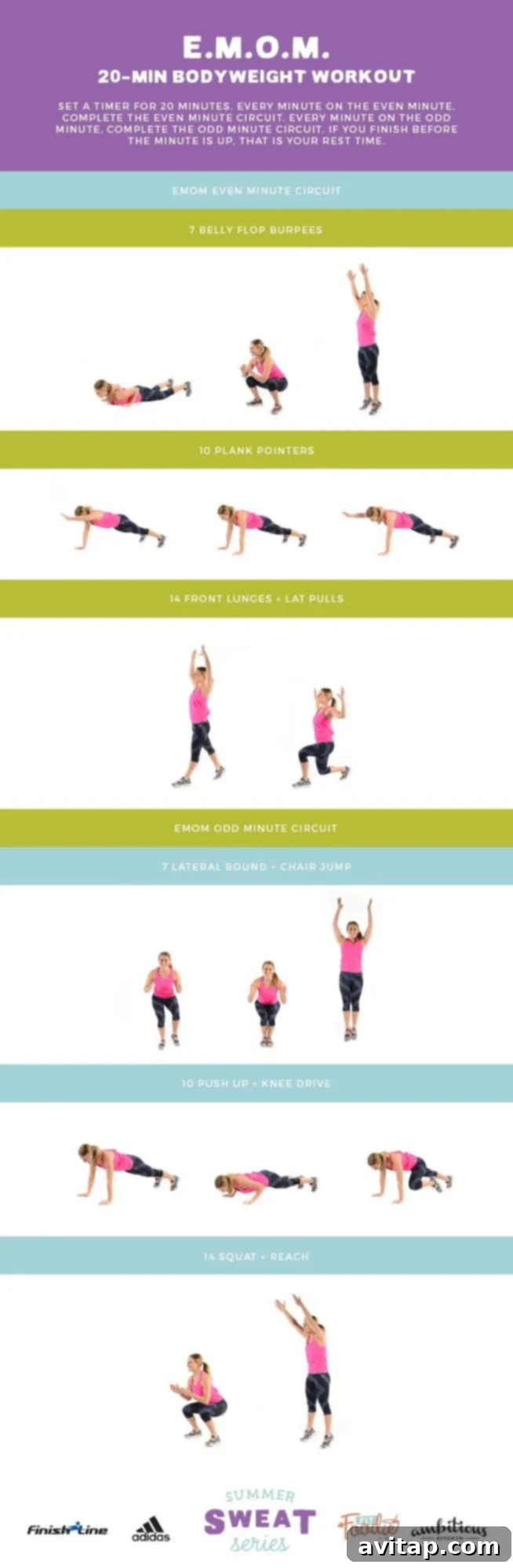
- Every ODD minute (Minutes 1, 3, 5, 7, 9, 11, 13, 15, 17, 19): You will perform the exercises listed under the ODD MINUTE CIRCUIT.
- Every EVEN minute (Minutes 2, 4, 6, 8, 10, 12, 14, 16, 18, 20): You will perform the exercises listed under the EVEN MINUTE CIRCUIT.
The core principle is simple: complete all specified repetitions for the current minute’s circuit with excellent form as quickly as possible. The remaining time in that minute is your active recovery. This structure encourages you to push hard during the work phase to earn a longer rest, ensuring both intensity and adequate recovery throughout the entire 20-minute session.
ODD MINUTE CIRCUIT (Minutes 1, 3, 5, 7, 9, 11, 13, 15, 17, 19)
7 Belly Flop Burpees
The Belly Flop Burpee is a full-throttle, full-body exercise that combines strength, cardio, and agility. It’s an advanced variation of the classic burpee, designed to maximize calorie burn and muscle engagement across your entire physique.
- Start Position: Begin standing tall with your feet slightly wider than hip-width apart. Distribute your weight evenly, keep your chest lifted, and maintain a braced core.
- Squat Phase: Lower your body into a deep squat, ensuring your weight remains in your heels and your chest stays upright.
- Plank Transition: Place your hands firmly on the ground just in front of your feet. With an explosive jump or a controlled step, move your feet back to a high plank position. Maintain a rigid, straight line from your head through your heels.
- Controlled Lowering (Belly Flop): Keeping your core extremely tight, lower your entire body to the ground using a controlled push-up motion. Lead with your chest until your stomach, hips, and chest make full contact with the floor simultaneously. Modification: If needed, drop to your knees for a more controlled descent to the ground.
- Hand Release & Re-plant: Briefly lift your hands off the floor as your chest makes contact, then quickly replant them near your chest.
- Explosive Push-Up: Powerfully push your body back up into a strong high plank position. Modification: Push up from your knees to high plank if maintaining strict form from the toes is too challenging.
- Return to Squat: From the high plank, jump or step your feet forward between your hands, landing softly in a low squat position.
- Vertical Explosion: Drive forcefully through your heels, exploding upwards into a standing position. Squeeze your glutes and hamstrings at the top. For an added cardio blast and power development, jump clear off the ground, extending your body fully and clapping your hands overhead. This marks the completion of one rep.
- Rep Pace: Complete 7 challenging reps. Focus on fluidity and power to maximize your work and earn more rest.
10 Plank Pointers (Alternating)
Plank Pointers are a phenomenal exercise for developing superior core stability, balance, and anti-rotational strength. This movement demands precise control to prevent unwanted hip movement and maintain a perfectly aligned spine.
- High Plank Setup: Begin in a strong, stable high plank position. Stack your shoulders directly over your wrists, spread your fingers wide to distribute your weight, and grip the floor. Your body should form a single, straight line from the crown of your head to your heels. Actively engage your core by drawing your navel towards your spine and pushing your heels towards the wall behind you. Keep your neck neutral with your gaze slightly forward.
- Core Engagement: Maintain this rigid plank position, ensuring your back remains flat and your core is fully braced throughout the entire movement.
- Dynamic Extension (Right Leg & Left Arm): Slowly and with utmost control, extend your right leg straight up off the ground (only a few inches) while simultaneously reaching your left arm straight out in front of you. The key is to keep your hips perfectly level and still; avoid any tilting or rotation.
- Controlled Return: Gently and deliberately return your right leg and left arm back to the starting high plank position.
- Switch Sides: Without pausing, immediately switch to the opposite side: lift your left leg and extend your right arm.
- Precision & Pace: Alternate sides for a total of 10 repetitions (5 per side). While you might be tempted to rush, prioritize control and stability. The smoother and more controlled your transitions are, the more effectively you will activate and strengthen your deep core muscles. Ensure your hips remain stable and your core continuously engaged.
14 Front Lunges & Lat Pull (Alternating)
This compound exercise powerfully targets your lower body for strength and stability, while simultaneously engaging your upper back muscles. It’s excellent for improving posture, balance, and building functional power.
- Athletic Starting Position: Stand tall with your feet shoulder-width apart and a slight bend in your knees, ready for dynamic movement.
- Step Forward & Reach: Take a significant step forward with your left foot, establishing a split stance. As you step, extend both arms straight overhead, palms facing forward.
- Lower & Pull: Begin to lower your body into a front lunge. Simultaneously, bend your elbows and pull them down towards your sides, as if performing a standing lat pulldown. Focus on squeezing your shoulder blades together to activate your upper back muscles.
- Lunge Depth & Arm Position: At the deepest point of the lunge, both knees should form a 90-degree angle. Ensure your front (left) knee remains safely aligned behind your toes. Your arms should be in a “goal-post” position (elbows bent at 90 degrees at shoulder height), with your back muscles fully engaged.
- Return to Start: Powerfully drive off your left front foot to return to the initial athletic standing position. This completes one full repetition.
- Alternating Movement: Immediately repeat the movement, alternating which leg steps forward for each lunge. Perform a total of 14 reps (7 per leg), maintaining a fluid and controlled rhythm.
EVEN MINUTE CIRCUIT (Minutes 2, 4, 6, 8, 10, 12, 14, 16, 18, 20)
7 Lateral Bound + Chair Jump
This explosive combination builds agility, lateral power, and vertical jumping ability. It’s a fantastic exercise for developing reactive strength, improving coordination, and significantly boosting your cardiovascular fitness.
- Initial Athletic Stance: Begin in a ready athletic stance, feet shoulder-width apart, knees slightly bent, and core engaged.
- Lateral Bound (Right to Left): Shift the majority of your weight onto your right leg. Explode powerfully off your right foot, leaping sideways across a short distance (a lateral bound). Land softly and with control on your left leg, immediately absorbing the impact by bending your knee and hip.
- Chair Jump (Squat Jump): As soon as you land on your left leg, quickly re-plant both feet on the ground. Immediately transition into a deep squat position (imagine sitting into a chair). Drive forcefully through your feet, exploding upwards, leaving the ground as you extend your hips and body fully.
- Soft Landing & Second Lateral Bound (Left to Right): Land softly on your feet, absorbing the impact with bent knees. Without hesitation, shift your weight onto your left leg and perform another lateral bound, exploding off your left foot and landing on your right leg.
- Consecutive Chair Jump: Re-plant both feet on the ground and immediately perform another chair jump (squat jump).
- Repetition & Flow: Each sequence of one lateral bound followed by one chair jump counts as one full rep. For clarity: (Right-to-Left Lateral Bound + Chair Jump) is one rep. (Left-to-Right Lateral Bound + Chair Jump) is the second rep. Complete a total of 7 full combo repetitions, focusing on smooth transitions and explosive power.
10 Push-Up + Knee Drive (Alternating)
This dynamic exercise is a powerhouse for upper body strength, particularly in the chest, shoulders, and triceps, while simultaneously challenging your core with a rapid knee drive. It’s an excellent compound movement for building functional full-body strength.
- Strong High Plank: Establish a robust high plank position. Ensure your hands are directly beneath your shoulders, fingers spread wide for optimal stability. Your body should form a perfectly straight and rigid line from the top of your head to your heels. Actively engage your core, pulling your kneecaps towards your belly button and pushing your heels backward. Maintain a neutral neck with your gaze slightly in front of you.
- Controlled Push-Up Descent: Slowly and with complete control, lower your chest towards the ground. Keep your elbows tucked close to your sides, creating an “arrow” shape with your arms, rather than letting them flare out. Maintain the straight body line throughout the descent – avoid any sagging in the hips or piking of the glutes.
- Explosive Push-Up Ascent: Once your chest is hovering just above the ground (or you’ve reached your maximum controlled depth), powerfully push back up to your starting high plank position.
- Dynamic Knee Drive (Right): Immediately upon reaching high plank, explosively drive your right knee towards your chest, or even towards your right elbow, engaging your lower abdominals intensely.
- Alternating Movement: Return your right foot to the plank position. Without pause, perform another full push-up. After the ascent, drive your left knee powerfully towards your chest or left elbow. Each push-up followed by an alternating knee drive (right/left) counts as one complete rep. Perform a total of 10 challenging reps, focusing on continuous core engagement.
14 Squat + Reach
The Squat + Reach is a fundamental yet highly effective exercise that strengthens your entire lower body and core. The added dynamic overhead reach enhances mobility, promotes full-body extension, and further engages your core muscles, making it a fantastic functional movement.
- Starting Stance: Begin with your feet slightly wider than hip-width apart. Your toes can point slightly outward or straight forward, depending on your natural and comfortable squat mechanics.
- Deep Squat Execution: Keeping your chest lifted and your weight firmly in your heels, lower down into a deep squat. Aim to get your hips below parallel with your knees, ensuring your knees track safely in line with your toes and do not collapse inward.
- Explode Up & Reach: Powerfully drive through your heels to stand tall. As you reach the top of the squat, simultaneously extend both arms straight overhead, pressing them forward slightly to create a full body extension.
- Core Engagement & Hold: At the peak of your overhead reach, actively engage your entire core, feeling a stretch through your torso and spine. Hold this fully extended position for a brief moment, maximizing the stretch and core activation.
- Fluid Repetition: Return your arms to your sides as you prepare for the next squat. This completes one repetition. Perform a total of 14 fluid and controlled repetitions. Focus on maintaining excellent form throughout, ensuring both a deep, stable squat and a complete, engaged overhead reach.
Why This 20-Minute Bodyweight EMOM Workout Is Your Ultimate Fitness Tool
This EMOM routine is more than just a sequence of exercises; it’s a strategically crafted program designed to deliver exceptional results efficiently. Here’s why this particular workout will become a cornerstone of your fitness journey:
- Unmatched Time Efficiency: In just 20 minutes, you engage every major muscle group and significantly elevate your cardiovascular fitness. It’s the perfect solution for individuals with demanding schedules.
- Zero Equipment, Zero Excuses: The beauty of bodyweight training means all you need is your own body. This makes high-quality fitness accessible anywhere – at home, in a hotel room, or outdoors in a park.
- Comprehensive Full-Body Engagement: From the explosive power of burpees and lateral bounds to the stabilizing strength of planks and the foundational power of squats, this workout ensures no muscle group is left behind. You’ll work your legs, core, upper body, and cardio system simultaneously.
- Powerful Cardio & Strength Synergy: The EMOM structure inherently combines high-intensity bursts of activity with short, active recovery periods. This effectively merges cardiovascular conditioning with strength building, leading to improved endurance and muscular resilience.
- Enhanced Functional Fitness: The movements in this workout mimic natural human biomechanics, improving your ability to perform daily activities with greater ease, power, and reduced risk of injury. You’ll move better, feel stronger, and have more energy.
- Boosted Mental Toughness: Consistently pushing through each minute and earning your rest periods fosters mental discipline and resilience. This mental fortitude gained in your workout will undoubtedly transfer to other challenges in your life.
Maximizing Your EMOM Workout: Essential Tips for Optimal Results
To ensure you get the most out of your 20-minute EMOM and maintain progress, keep these vital tips in mind:
- Prioritize Impeccable Form Over Speed: While completing reps quickly is part of the EMOM challenge, never compromise on proper technique. Incorrect form can lead to injury and diminishes the effectiveness of the exercise. If your form starts to falter, slow down or opt for a modification. Quality always trumps quantity.
- Listen Intently to Your Body: Pay close attention to how your body responds to each movement. If you experience any sharp or unusual pain, stop the exercise immediately. This workout is highly adaptable; feel free to modify movements as needed to match your current fitness level and respect any physical limitations.
- Maintain Optimal Hydration: Proper hydration is fundamental for performance, muscle function, and recovery. Ensure you drink plenty of water throughout the day, especially before, during, and after your workout.
- Focus on Controlled Breathing: Conscious breathing can significantly impact your performance and endurance. Generally, inhale deeply during the eccentric (lowering or less strenuous) phase of an exercise and exhale forcefully during the concentric (pushing or most strenuous) phase.
- Track and Celebrate Your Progress: Consider noting down how quickly you complete each circuit within the minute. Over time, you’ll likely find yourself finishing reps faster, indicating improved fitness and efficiency. This tangible progress can be a powerful motivator!
- Embrace Consistency: The best results come from regular effort. Aim to incorporate this EMOM workout into your routine 3-4 times per week, allowing for adequate rest and recovery days in between sessions.
- Safely Push Your Limits: Once you feel confident and proficient with the movements, challenge yourself to increase your pace and intensity while rigorously maintaining perfect form. The shorter your work time within the minute, the longer your rest, but always ensure you are genuinely exerting maximum effort during the work phase.
Post-Workout Protocol: Cool-Down & Stretching (5-7 Minutes)
Following an intense EMOM session, a dedicated cool-down is crucial. It helps gradually lower your heart rate, flushes metabolic byproducts from your muscles, improves flexibility, and signals to your body that it’s time for recovery and repair.
- Gentle Cardio Wind-Down (1-2 minutes): Begin with light, non-strenuous movement to slowly bring your heart rate back to a resting state.
- Slow walking in place or a gentle stroll.
- Light arm swings and gentle torso rotations.
- Static Stretching (4-5 minutes): Hold each stretch for 20-30 seconds, breathing deeply and relaxing into the stretch. Avoid bouncing, which can cause muscle strain.
- Quad Stretch: Standing, grab your right ankle with your right hand and gently pull your heel towards your glute. Keep knees close. Repeat on the left side.
- Hamstring Stretch: Sit on the floor, extend one leg straight out, and bend the other leg with your foot against your inner thigh. Reach for the toes of your extended leg. Repeat on the other side.
- Calf Stretch: Stand facing a wall, place your hands on it. Step one foot back, keeping that heel firmly on the ground, and lean forward into the stretch. Repeat for both calves.
- Triceps Stretch: Reach one arm overhead, bend your elbow so your hand drops behind your head. Use your other hand to gently press down on the elbow. Switch arms.
- Chest Stretch: Stand in a doorway. Place your forearms on the doorframe, then gently step forward to feel a stretch across your chest and shoulders.
- Glute Stretch (Figure Four): Lie on your back. Cross your right ankle over your left knee. Gently pull your left knee towards your chest to feel a stretch in your right glute. Repeat on the other side.
Disclaimer: Always consult your doctor before starting any new fitness regime. While Lee from Fit Foodie Finds and Monique from Ambitious Kitchen worked with a professional trainer to design the Summer Sweat Series exercise program, you are participating at your own risk. Please listen to your body and modify as needed to ensure your safety and well-being.