

Torch Calories at Home: Your Ultimate 25-Minute No-Equipment Tabata HIIT Workout for Lower Body Strength
That familiar soreness creeping in? We’ve all been there – waking up the day after an intense leg day can feel like a badge of honor, or sometimes, just a lot of “Owwwwwwwieeeee.” But that feeling signifies progress, and today’s workout is designed to push your limits, strengthen your lower body, and ignite your metabolism, all without needing any special equipment. Get ready to transform your fitness from the comfort of your home!
This session is a powerful blend of lower body strength, heart-pumping cardio, and high-intensity interval training (HIIT). I’m a huge advocate for no-equipment HIIT and Tabata workouts. My yoga sculpt classes often integrate these dynamic segments because I genuinely believe they are among the most effective and time-efficient workouts you can do, fitting seamlessly into any schedule or space. They prove that you don’t need a gym full of machines to achieve remarkable fitness results.
The Power of HIIT: Transform Your Fitness Fast
High-Intensity Interval Training, or HIIT, is a game-changer for fitness enthusiasts and beginners alike. It involves short bursts of maximum-effort exercise followed by brief periods of rest or low-intensity recovery. This cycle is then repeated, creating a powerful physiological response in your body. The magic of HIIT lies in its ability to rapidly spike your heart rate, pushing your cardiovascular system to work harder, before bringing it back down, only to elevate it again during the next intense burst.
This rollercoaster of intensity doesn’t just feel good; it delivers tangible, scientifically-backed benefits. HIIT is incredibly effective at boosting your metabolism, leading to a phenomenon known as the “afterburn effect” or EPOC (Excess Post-exercise Oxygen Consumption). This means your body continues to burn calories at an elevated rate even after your workout is finished, sometimes for hours! Beyond increased calorie expenditure, regular HIIT sessions significantly improve your overall cardiovascular fitness, endurance, and muscular strength. What does that translate to? You might find your daily activities feeling easier, your energy levels soaring, and yes, potentially even enjoying a little extra wiggle room in your diet without compromising your fitness goals. #boomsauce indeed!
Perhaps one of the most compelling aspects of HIIT is its efficiency. These workouts are short, sweet, and incredibly potent. You don’t need to dedicate hours to the gym to see results. A focused 30-minute HIIT session, or even less, is often all it takes to challenge your body, boost your fitness levels, and achieve remarkable improvements. It’s the perfect solution for those with busy schedules who still want to make fitness a priority.
Why Tabata? Structured Intensity for Maximum Results
Within the realm of HIIT, the Tabata Protocol stands out as a personal favorite, and for good reason. A classic Tabata round is a four-minute powerhouse, meticulously structured to maximize your output. It consists of eight intervals: 20 seconds of all-out, high-intensity exercise followed by 10 seconds of complete rest or low-intensity recovery. This precise timing allows for maximum effort during the work phases and just enough recovery to prepare for the next burst, ensuring you maintain a high level of intensity throughout the entire round.
One of the brilliant aspects of Tabata is its accessibility and motivation factor. Thanks to platforms like Spotify, there are amazing Tabata-specific playlists that act as your personal timer and motivational “jukebox.” These tracks audibly guide you through the 20-second work periods and 10-second rest periods, eliminating the need to constantly watch a clock. It’s like having a personal trainer and a DJ all rolled into one! This allows you to focus 100% on your movement, effort, and form, rather than being distracted by timekeeping. But beyond the practical benefits of timing, Tabata’s structured nature provides a unique psychological advantage: you know precisely how long you need to push and, just as importantly, when that glorious feeling of accomplishment (and the end of the “pain”) will arrive. This predictability can be a powerful motivator, helping you push through those final challenging seconds, knowing a brief but well-deserved rest is just around the corner.
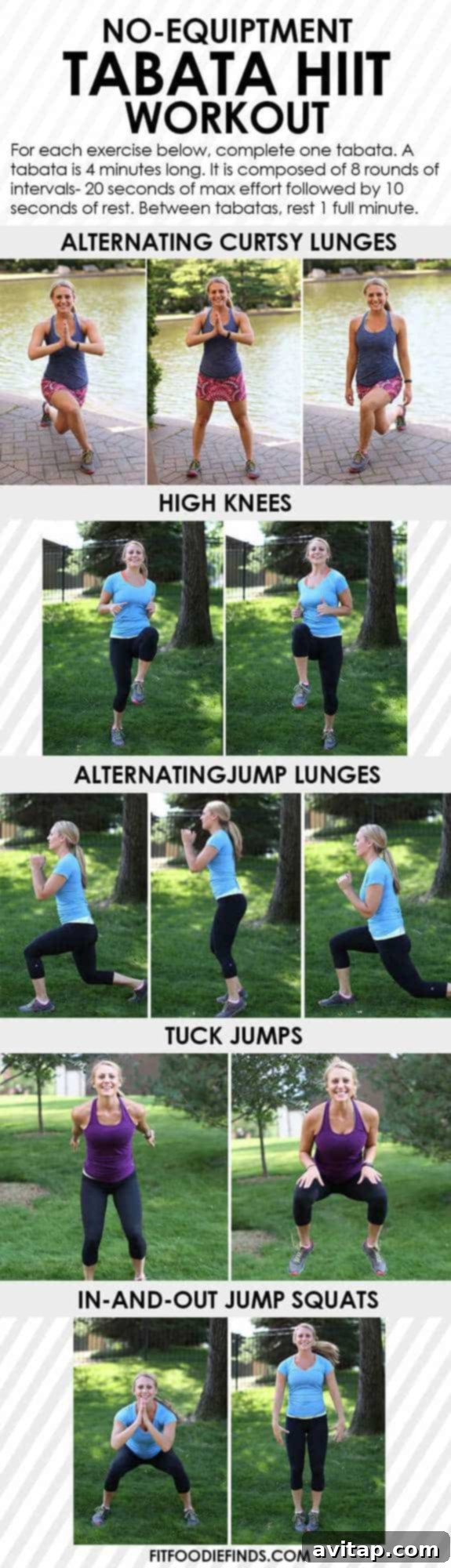
Your 25-Minute No-Equipment Tabata Workout Overview
This comprehensive workout is designed to take approximately 25 minutes to complete, a perfect duration to fit into a busy day. It comprises five full Tabata rounds, each lasting four minutes. The exercises are strategically chosen to engage your entire lower body, elevate your heart rate, and build functional strength and endurance. While primarily a no-equipment routine, we’ll provide modifications (regressions) to make exercises easier or accommodate joint sensitivities, as well as challenges (progressions) for those looking to amplify the intensity or incorporate weights if you happen to have access to a gym or dumbbells at home. This ensures the workout is scalable for all fitness levels, from beginners to seasoned athletes.
Before You Begin: Essential Considerations for a Safe and Effective Workout
- Warm-Up: Never skip your warm-up! Dedicate 5-10 minutes to light cardio like marching in place, arm circles, leg swings, and dynamic stretches. This prepares your muscles and joints for the strenuous activity ahead, increasing blood flow, improving flexibility, and significantly reducing the risk of injury. A proper warm-up also enhances your performance by getting your body primed for action.
- Hydration: Ensure you are well-hydrated before, during, and after your workout. Keep a water bottle handy and sip regularly. Staying hydrated is crucial for energy levels, muscle function, and overall well-being, especially during high-intensity exercise.
- Listen to Your Body: While the goal is high intensity, always pay attention to your body’s signals. It’s okay to slow down, take extra rest, or choose a regression if you need to. Pushing too hard beyond your limits can lead to injury and burnout. This workout is about challenging yourself safely and sustainably.
- Form Over Speed: Always prioritize proper form over speed or the number of repetitions. Maintaining correct technique ensures you’re effectively targeting the right muscles, maximizing the benefits of each exercise, and most importantly, staying safe from potential injuries. If your form starts to break down, slow down or take a brief pause.
Your No-Equipment Tabata Workout: Exercise Breakdown
Alternating Curtsy Lunge
The alternating curtsy lunge is an excellent exercise for targeting your glutes, outer thighs (abductors), and improving balance and hip mobility. To begin, stand with your feet hip-width apart, core engaged, and chest lifted. Take a deliberate step back with your right leg, crossing it behind your left leg, so your right foot lands to the left of your left foot. As you step back, simultaneously bend both knees, lowering your hips towards the floor as if performing a graceful curtsy. Ensure your front knee remains stacked directly over your ankle and your back knee hovers just above the ground. Your torso should remain upright. Drive powerfully through your front heel to return to the starting position, standing tall with feet hip-width apart. Alternate sides, focusing on a smooth, controlled movement and maintaining a flat back throughout the entire exercise. Feel the stretch in your outer hip and the burn in your glutes.
- Regression: For less impact, improved balance, or if you’re new to the movement, perform stationary curtsy lunges. Complete all 20 seconds on one leg, then switch to the other leg for the next 20-second work interval, alternating legs every round. This allows for more stability and focus on the movement pattern without the alternating jump.
- Progression: To significantly increase the challenge, incorporate light to medium dumbbells. As you stand up from the lunge, perform an upright row, pulling the dumbbells towards your chin with elbows flared out. This adds an upper body component, further elevates your heart rate, and engages more muscles simultaneously.
High Knees
High knees are a fantastic cardiovascular exercise that also engages your core and strengthens your hip flexors, improving running mechanics and explosive power. Start standing with your feet hip-width distance apart, looking straight ahead, and arms bent at a 90-degree angle, ready to pump. Begin running vigorously in place, driving your knees up towards your chest as high as possible, aiming for your thighs to be parallel to the floor. Use your arms actively, pumping them back and forth just as you would while sprinting to generate momentum and maintain rhythm. Maintain a tall posture, keeping your chest lifted, shoulders relaxed, and core tightly engaged to protect your lower back and maximize efficiency. Focus on light, quick feet as you drive those knees up, making minimal contact with the ground.
- Regression: To reduce the plyometric (jumping) impact, slow your pace down and perform a marching high knee. Bring one elbow to the opposite knee with a controlled twist, focusing on core engagement. This version still engages your core and hip flexors but is gentler on the joints, making it suitable for warm-ups or low-impact days.
- Progression: For an increased challenge and greater core engagement, keep your arms extended straight up and above your head throughout the entire exercise. This elevates your center of gravity, demanding more stability from your core and increasing the cardiovascular intensity.
Alternating Jump Lunges
Alternating jump lunges are a powerful plyometric exercise that builds explosive lower body strength, improves agility, and significantly boosts your cardiovascular endurance. Begin in a staggered stance, or “scissored position,” with one leg forward and the other back, both knees slightly bent, and your chest lifted. Inhale as you drop down into a lunge position, aiming for both knees to be at a 90-degree angle, ensuring your front knee is stacked directly over your ankle and your back knee hovers above the ground. As you exhale, explode powerfully upwards, jumping off the ground and switching your leg positions mid-air. Land softly with the opposite leg in front, immediately absorbing the impact by dropping back into a lunge. Continue to alternate quickly and fluidly, maintaining control and proper form with each jump. Focus on a controlled, quiet landing to protect your joints and minimize impact. The quicker your transition, the higher your heart rate will climb!
- Regression: If jump lunges are too intense or hard on your joints, perform stationary lunges. Complete 20 seconds with one leg forward, then switch to the other leg for the next 20-second work interval. This allows you to build strength and stability without the high-impact jumping.
- Progression: To further increase the intensity and muscle engagement, hold a 5-10 pound dumbbell or a weight plate in each hand as you perform the alternating jump lunges. The added resistance will make each jump more challenging and enhance your power output and muscular endurance.
Tuck Jumps
Tuck jumps are an advanced plyometric exercise designed to develop explosive power, agility, and overall athletic performance, engaging your entire lower body and core. Start with your feet hip-width distance apart, knees slightly bent, and arms ready to swing for momentum. Initiate the movement by quickly dropping into a shallow squat, then explode upwards with maximum effort, driving your knees forcefully towards your chest. Aim to pull your knees as high as possible, as if trying to “tuck” them into your torso. Use your arms to help propel you upwards and bring your knees higher. Land softly on the balls of your feet, immediately absorbing the impact by bending your knees, and quickly prepare for the next jump. Focus on a quick rebound and maintaining a strong, stable core throughout the movement to protect your spine. The goal is to minimize ground contact time.
- Regression: If tuck jumps are too high-impact or challenging, perform butt kicks instead. This involves running in place while actively kicking your heels towards your glutes. It’s a great cardio exercise that’s gentler on the knees while still elevating your heart rate and engaging your hamstrings.
- Progression: For an even greater challenge and to combine power with strength, after you perform each tuck jump, immediately lower down into a full squat. This adds an extra compound movement, increasing time under tension and muscular endurance in your quads and glutes. Repeat this powerful combination for each interval.
In and Out Jump Squats
In and out jump squats are a dynamic exercise that targets your glutes, quadriceps, and inner/outer thighs while significantly boosting your cardiovascular endurance and agility. Begin in a standing position with your feet hip-width distance apart. As you inhale, lower down into a squat, keeping your chest lifted, back flat, and ensuring the weight is distributed evenly, primarily in your heels. Your knees should track over your toes, and your hips should descend as if sitting back into a chair, ideally breaking parallel. As you exhale, explode powerfully off the ground, jumping your feet together in the air. Land softly with your feet together, immediately jumping back out into your squat position, maintaining a controlled and fluid motion. This continuous in-and-out jumping and squatting sequence keeps your heart rate high and leg muscles intensely engaged. Focus on soft landings to protect your joints.
- Regression: If the jumping element is too intense or hard on your joints, perform normal squats instead. Focus on excellent form, lowering your hips below parallel if possible, and driving through your heels to stand up. You can alternate between a wide stance (sumo squat) and hip-width stance squats each round to work different angles of your legs.
- Progression: To amplify the intensity and increase muscular demand, hold a 5-10 pound dumbbell or a weight plate in your hands, holding it at chest level (goblet squat style) as you perform the in and out jump squats. The added resistance will increase the demand on your leg muscles, making the exercise more challenging and effective.
Integrating Music: Your Tabata Soundtrack for Success
Before you dive into this calorie-torching workout, I have a crucial recommendation! Firstly, if you don’t already have one, you absolutely should get a Spotify account – it’s a game-changer for workout motivation. Secondly, and perhaps more importantly for this workout, you NEED to check out my dedicated Tabata Playlist on Spotify! I’ve curated a fantastic selection of songs that are specifically designed to coach you through your Tabata intervals. These tracks don’t just play music; they feature audible cues that tell you precisely when to work and when to rest, eliminating the need to constantly check a timer. It’s like having a personal trainer and a DJ all rolled into one, keeping you motivated and on track! This allows you to focus 100% on your effort and form, ensuring you get the most out of every single 20-second burst. SCOREEEE. Go check it out and let the music guide your intensity:
Cool-Down and Stretching: Essential for Recovery
After pushing your body through these intense Tabata rounds, a proper cool-down is just as vital as your warm-up. Dedicate 5-10 minutes to bring your heart rate down gradually and stretch your major muscle groups. Begin with gentle walking or marching in place to help normalize your breathing and circulation. Follow this with static stretches, holding each stretch for 20-30 seconds, focusing on your glutes, hamstrings, quadriceps, and calves. Examples include a quad stretch, hamstring stretch (standing or seated), glute stretch (figure-four stretch), and calf stretch. This helps improve flexibility, reduce post-workout muscle soreness (DOMS), and aids in overall recovery, preparing your body for its next challenge. Don’t skip this crucial step!
Final Thoughts & Stay Motivated!
This 25-minute no-equipment Tabata HIIT workout is a testament to what you can achieve with structured intensity and unwavering commitment. Whether you’re completing it in your living room, a hotel room, or even daring to take it to the gym (like I did the other day – headphones in, crushing 8 rounds, and probably looking like a wacko!), this routine is incredibly effective for boosting your fitness. Remember, consistency is key to seeing lasting results, and every single workout brings you closer to your health and fitness goals. Embrace the burn, celebrate your strength, and enjoy the incredible, transformative benefits of high-intensity interval training. You’ve got this! Get itttt!