

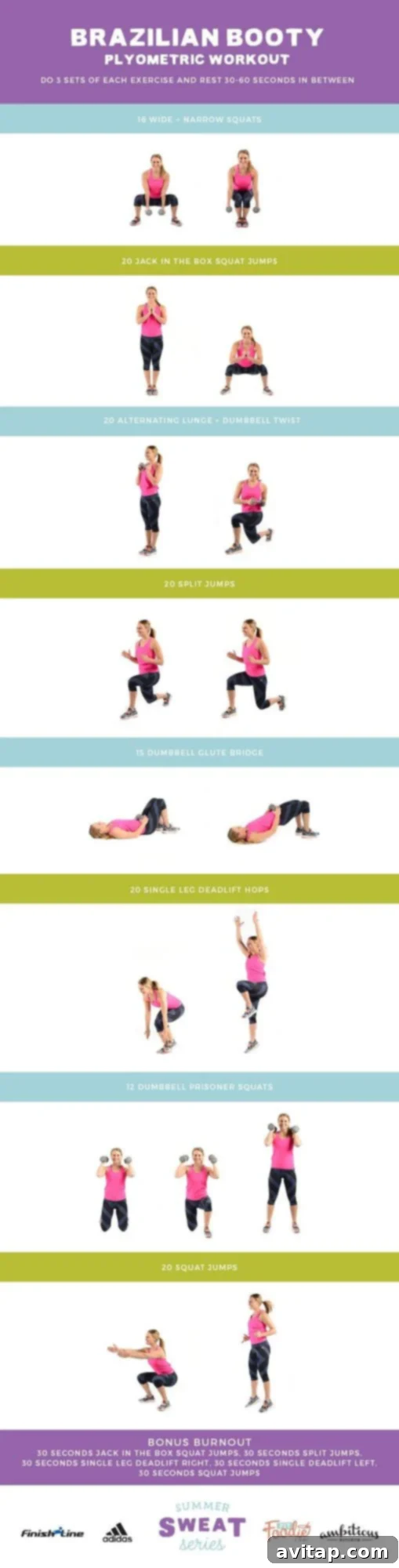
Brazilian Booty Plyometric Workout: Sculpt Strong, Lifted Glutes
Dreaming of a stronger, more defined lower body? This Brazilian Booty Plyometric Workout is meticulously designed to help you achieve just that. By blending dynamic plyometric movements with targeted lower body strength training, this routine delivers an unparalleled challenge, specifically focusing on your glutes, hamstrings, and quads. Get ready to ignite your muscles, boost your metabolism, and carve out the powerful, sculpted physique you desire right from the comfort of your home.
Plyometrics, often referred to as ‘jump training,’ are exercises where muscles exert maximum force in short intervals, with the goal of increasing power. Incorporating these explosive movements into your routine not only enhances athletic performance but also significantly boosts calorie burn and helps in building lean muscle mass. Combined with classic strength exercises, this workout ensures comprehensive muscle engagement, leading to remarkable results in glute strength and definition.
Workout Overview and Preparation
To ensure a safe and effective workout, proper preparation is key. This circuit-based routine is structured for maximum impact, demanding focus on form and consistent effort.
Equipment Needed:
- Medium to heavy dumbbells: Essential for adding resistance to your strength exercises, intensifying muscle engagement and promoting growth.
Warm-Up (5-10 minutes):
Never skip your warm-up! It prepares your body for the strenuous activity ahead, increasing blood flow to your muscles, improving flexibility, and reducing the risk of injury. Start with light cardio to elevate your heart rate, followed by dynamic stretches that mimic the movements of the workout. Examples include:
- Light walk or jog
- High Knees
- Butt Kicks
- Jumping Jacks
- Arm Circles
- Torso Twists
- Air Squats with overhead arm reach
- Leg Swings (forward and side-to-side)
Workout Description:
This program is structured as a circuit. You will perform 3 sets of each exercise before moving on to the next. Rest for 30-60 seconds between sets to allow for partial recovery while keeping your heart rate elevated. Focus on controlled movements and engaging the target muscles throughout each repetition.
The Brazilian Booty Plyometric Workout Circuit
Circuit
1. Wide + Narrow Squats (16 Reps)
This exercise targets your glutes and inner thighs effectively by varying your stance, ensuring comprehensive lower body activation.
- Begin by standing with your feet touching, holding a dumbbell in each hand at your sides. Maintain an upright chest and engaged core.
- Initiate the squat by pushing your hips back and lowering your body toward the ground until your thighs are parallel with the floor. Ensure your weight remains in your heels.
- Drive through your heels to return to the starting position, straightening your legs and powerfully squeezing your glutes at the top of the movement. This completes the narrow squat.
- Immediately take a large step to the right with your right leg, creating a wide stance. Lower into another squat, this time allowing the dumbbells to hang between your legs.
- Explode back up, squeezing your glutes, and step your right foot back to the narrow stance, feet touching.
- Repeat the movement, alternating the wide step to the right and then to the left. This constitutes one full repetition (narrow-wide-narrow on one side, then narrow-wide-narrow on the other side).
Form Focus: Keep your back straight, chest lifted, and knees tracking over your toes. The transition between narrow and wide stances should be fluid and controlled.
2. Jack In the Box Squat Jumps (16 Reps)
An explosive plyometric movement that elevates your heart rate while building powerful glutes and quads. It combines lateral movement with a vertical jump for maximum impact.
- Start in a wide stance, feet wider than shoulder-width apart, and lower into a deep squat. Touch your fingertips to the ground between your legs, keeping your chest up and core tight.
- From this low squat, explode upward, driving through your heels. As you jump, bring your feet together in mid-air and extend your arms straight overhead.
- Land softly back into the wide squat position, immediately touching your fingertips to the ground again to absorb the impact and prepare for the next jump.
- Maintain a continuous, fluid motion, alternating between the wide squat position and the narrow jump. Engage your core throughout the entire movement for stability and power.
Form Focus: Ensure soft landings to protect your joints. Use your glutes and quads to power the jump, not just your knees.
3. Alternating Lunge + Twist (20 Reps)
This dynamic exercise not only sculpts your legs and glutes but also engages your core and obliques, adding a rotational element for functional strength.
- Stand tall with your feet hip-width apart, holding a medium to heavy dumbbell horizontally with both hands at chest level.
- Step forward with your right leg, lowering your hips until both knees are bent at approximately a 90-degree angle. Ensure your front knee is stacked directly over your ankle and your chest remains upright.
- While in the lunge position, rotate your upper body to the right, keeping your spine aligned and core tight. Feel the twist in your obliques.
- Controlled, rotate your upper body back to the center, then push off your front foot to step back to the starting standing position.
- Repeat the entire sequence, stepping forward with your left leg and twisting to the left. Continue to alternate legs for the specified number of repetitions.
Form Focus: Keep your core braced during the twist to protect your lower back. Maintain balance and stability throughout the lunge.
4. Split Jumps (20 Reps)
A highly effective plyometric exercise for building explosive power in the legs and glutes, while also challenging your balance and coordination.
- Begin by taking a large step backward with your left foot, lowering into a reverse lunge. Both knees should be bent at a 90-degree angle, with your front (right) knee positioned behind your toes.
- From the bottom of the lunge, engage your core and explode upward, pushing off forcefully with both feet.
- In mid-air, quickly switch the position of your feet.
- Land softly back into a low lunge position, this time with your right foot back and your left foot forward. Ensure your back leg is bent directly underneath your body, and your front leg forms a 90-degree angle at the knee and hip.
- Maintain a continuous, alternating jump sequence, focusing on smooth transitions and controlled landings.
Form Focus: Emphasize height and speed in the jump, but prioritize soft, controlled landings to protect your joints and maximize muscle activation.
5. Dumbbell Glute Bridge (20 Reps)
An isolation exercise that primarily targets the glutes, helping to build strength, improve posture, and enhance the “lifted” appearance of the glutes. The dumbbell adds extra resistance.
- Lie on your back on the floor, bending your knees with your feet flat on the ground, shoulder-width apart. Position a dumbbell across your hips for added resistance, holding it with both hands.
- Keep your chin slightly tucked towards your chest, gazing up at the ceiling, to maintain a neutral spine.
- Drive through your heels, pressing your hips upward toward the ceiling. Focus on powerfully squeezing your glutes at the top of the movement, ensuring your knees remain in line with your toes.
- Continue lifting until your body forms a straight line from your shoulders to your knees. Hold this peak contraction for a second.
- Slowly lower your hips back down to the starting position with control.
- This completes one repetition. Repeat for the specified number of reps, maintaining constant tension in your glutes.
Form Focus: Avoid arching your lower back excessively at the top. The movement should come from your glutes, not your lower back.
6. Single Leg Deadlift Hops (20 Reps per Leg)
This advanced exercise challenges your balance, stability, and strengthens the posterior chain, particularly the glutes and hamstrings, while adding a plyometric element.
- Start standing with your feet together, arms at your sides.
- Shift your weight onto your left leg and lift your right leg slightly off the ground, keeping your right ankle close to your left ankle. This is your starting balance position.
- Engage your core and hinge at your hips, lowering your upper body forward while extending your right leg straight back behind you for counterbalance. Keep a slight bend in your standing left knee. You can tap the ground with your fingertips if your flexibility allows.
- From this deadlift position, explode straight up off your left leg, driving your knee upwards and leaving the ground for a brief hop, if possible.
- Land softly back on your left leg, immediately moving into the single-leg deadlift position to absorb the impact and prepare for the next hop.
- Repeat this movement for the specified number of reps on your left leg, then switch and perform the same number of reps on your right leg.
Form Focus: Maintain a neutral spine throughout the deadlift. Control the hop and land softly to maximize the plyometric effect and minimize joint impact.
7. Dumbbell Prisoner Squats (12 Reps)
A unique exercise that transitions from a standing squat to a kneeling position and back, building comprehensive leg and glute strength, especially focusing on the eccentric phase.
- Stand with your feet shoulder-width apart, toes pointing forward. Hold a dumbbell in each hand, resting them lightly on your shoulders.
- Slowly lower down into a deep squat position.
- From the bottom of the squat, carefully lower one knee to the ground, followed by the other knee, until you are in a kneeling position with the dumbbells still at your shoulders.
- Engage your core, and step one foot up at a time, pushing through your heel to return to the standing squat position.
- Finally, drive through your heels to stand fully upright, squeezing your glutes.
- This sequence (standing squat to kneeling and back to standing) constitutes one repetition. Alternate which knee goes down first with each rep. Maintain a strong, engaged core throughout.
Form Focus: Control the descent and ascent carefully. This exercise emphasizes stability and controlled strength rather than speed.
8. Squat Jumps (20 Reps)
The foundational plyometric movement for the lower body, excellent for building explosive power, strengthening glutes and quads, and improving vertical jump height.
- Begin in a neutral standing position, feet shoulder-width apart, with your arms relaxed at your sides.
- Initiate the squat by pushing your hips back as if you’re sitting into an imaginary chair. Keep your weight in your heels, chest lifted, core engaged, and gaze forward. Lower until your thighs are parallel to the floor or deeper if your mobility allows.
- From the bottom of your squat, powerfully drive through the entire sole of your feet, exploding upward. Push your hips forward and swing your arms back behind you for momentum as you leave the ground.
- Land softly back on your feet, immediately returning to the low squat position to absorb the impact and prepare for the next jump.
- Maintain a continuous, rhythmic motion, focusing on maximum height with each jump and controlled landings.
Form Focus: Always land softly, bending your knees to absorb the shock. This protects your joints and allows for immediate transition into the next rep.
Maximizing Your Workout: Warm-up, Cool-down, and Progression
Beyond the circuit itself, the success of your fitness journey relies on holistic practices. A proper warm-up, effective cool-down, and strategic progression are crucial for achieving optimal results and ensuring long-term health.
The Importance of a Dynamic Warm-up
As mentioned, a warm-up is non-negotiable. It increases your body temperature, loosens up your muscles and joints, and mentally prepares you for the demanding workout ahead. By gradually increasing blood flow and activating muscle groups, you significantly reduce the risk of strains and injuries. Dynamic stretches, which involve movement, are superior to static stretches pre-workout as they prepare your muscles for activity without reducing power output.
Cool-Down and Static Stretching (5-10 minutes)
After pushing your body through this intense circuit, a cool-down is essential for recovery. It helps to gradually lower your heart rate, reduce muscle soreness, and improve flexibility. Dedicate 5-10 minutes to static stretches, holding each stretch for 20-30 seconds. Focus on the muscle groups you’ve just worked:
- Quad Stretch
- Hamstring Stretch (e.g., standing toe touch or seated hamstring stretch)
- Glute Stretch (e.g., figure-four stretch or pigeon pose)
- Calf Stretch
- Hip Flexor Stretch
Progression for Optimal Results
To continue seeing progress, your body needs to be consistently challenged. This concept, known as progressive overload, can be applied in several ways:
- Increase Reps or Sets: Once you can comfortably complete the specified reps and sets, try adding a few more repetitions to each set or an additional set for the entire circuit.
- Increase Weight: When your current dumbbells no longer feel challenging, gradually increase the weight. Even a small increment can make a significant difference.
- Decrease Rest Time: Shortening the rest period between sets or exercises can increase the intensity and improve your cardiovascular endurance.
- Improve Form: Continuously refine your technique. Perfect form ensures maximum muscle activation and prevents injury, making the workout more effective.
- Increase Frequency: If your body allows, consider performing this workout 2-3 times a week, ensuring adequate rest days in between.
Remember, consistency is paramount. Regular adherence to your workout routine, combined with a balanced diet and sufficient sleep, will yield the best results for your Brazilian booty transformation.
Bonus Burnout: Take Your Challenge to the Next Level
For those days when you have extra energy or want an ultimate finisher, this mini-circuit will truly push your limits and leave your glutes burning!
- 30 seconds Hopscotch Squats: A rapid, alternating wide-to-narrow squat jump.
- 30 seconds Heisman Bounds: Lateral bounds with a high knee, emphasizing agility and power.
- 30 seconds Dumbbell Swings: A powerful hip-hinge movement for glutes and hamstrings.
- 30 seconds Lunge + Squat Jumps: Combine a lunge jump with a squat jump for a dynamic combo.
Perform each exercise back-to-back with minimal rest, completing the entire mini-circuit once for a quick, intense burst of energy and muscle fatigue.
Safety First: Important Disclaimer
Disclaimer: Always consult your doctor before starting a new fitness regime. While Lee from Fit Foodie Finds and Monique from Ambitious Kitchen worked with a professional trainer to design the Summer Sweat Series exercise program, you are participating at your own risk. Please listen to your body and modify as needed. If you experience any pain or discomfort, stop immediately and seek medical advice.