
Ultimate Upper Body & Core Stability Workout for Strength and Balance
Welcome to a truly transformative workout experience! If you’re looking to not only sculpt a stronger upper body but also fortify your core with unparalleled stability, you’ve come to the right place. This comprehensive workout routine is meticulously designed to challenge your muscles, enhance your balance, and improve your overall functional fitness. Combining dynamic movements with focused stability challenges, you’ll engage your midsection in ways that go beyond traditional crunches, leading to improved posture, reduced injury risk, and a more powerful physique.
Our goal is to help you achieve a robust and resilient body. This routine targets major upper body muscle groups while simultaneously demanding constant engagement from your core stabilizers. Whether you’re a seasoned athlete or just starting your fitness journey, the exercises can be modified to suit your current fitness level, ensuring an effective and safe workout for everyone. Get ready to feel the burn, build lasting strength, and embrace a new level of physical capability!
Understanding the Power of Upper Body & Core Stability
The combination of upper body strength and core stability is the cornerstone of functional fitness. A strong core acts as the body’s powerhouse, supporting movement, protecting the spine, and transferring force between the upper and lower body. When your core is stable, your upper body exercises become more effective, allowing you to lift heavier, perform movements with better form, and reduce the risk of injury.
This workout emphasizes stability because traditional strength training often neglects the deeper stabilizing muscles. By incorporating elements like physio balls and bosu balls, we introduce an unstable surface that forces these smaller, crucial muscles to activate, leading to greater overall strength, improved balance, and enhanced body control. This isn’t just about looking good; it’s about moving better, feeling stronger, and building a foundation for lifelong fitness.
Equipment You’ll Need for This Workout
To get the most out of this stability-focused workout, you’ll need a few key pieces of equipment. Each item plays a vital role in challenging your balance and providing resistance for muscle growth.
- Medium and Heavy Dumbbells: Essential for adding resistance to your upper body and core exercises. Having a range allows you to scale the weight up or down depending on the exercise and your current strength level. For stability exercises, sometimes a lighter weight can be more challenging due to the balance component.
- Bench: A sturdy workout bench provides elevation and a stable surface for exercises like inverted rows. It’s also versatile for various other bodyweight and dumbbell movements.
- Bosu Ball: This half-sphere, half-flat surface is incredible for challenging your balance and engaging deep core stabilizers. Whether you use the dome side up or down, it creates an unstable environment that forces your muscles to work harder.
- Physio Ball (Stability Ball): A large inflatable ball used for a wide range of exercises. It’s excellent for core work, providing an unstable base that enhances muscle activation, and also offers support for certain movements.
Ensure your equipment is in good condition and suitable for your weight before starting your workout.
Your Dynamic Workout Circuit: Structure and Guidelines
This workout is structured as a circuit, meaning you’ll move from one exercise to the next with minimal rest between them. Once you’ve completed all exercises in the circuit, you’ll take a short break before starting the next round. This approach keeps your heart rate elevated, boosts endurance, and maximizes calorie burn.
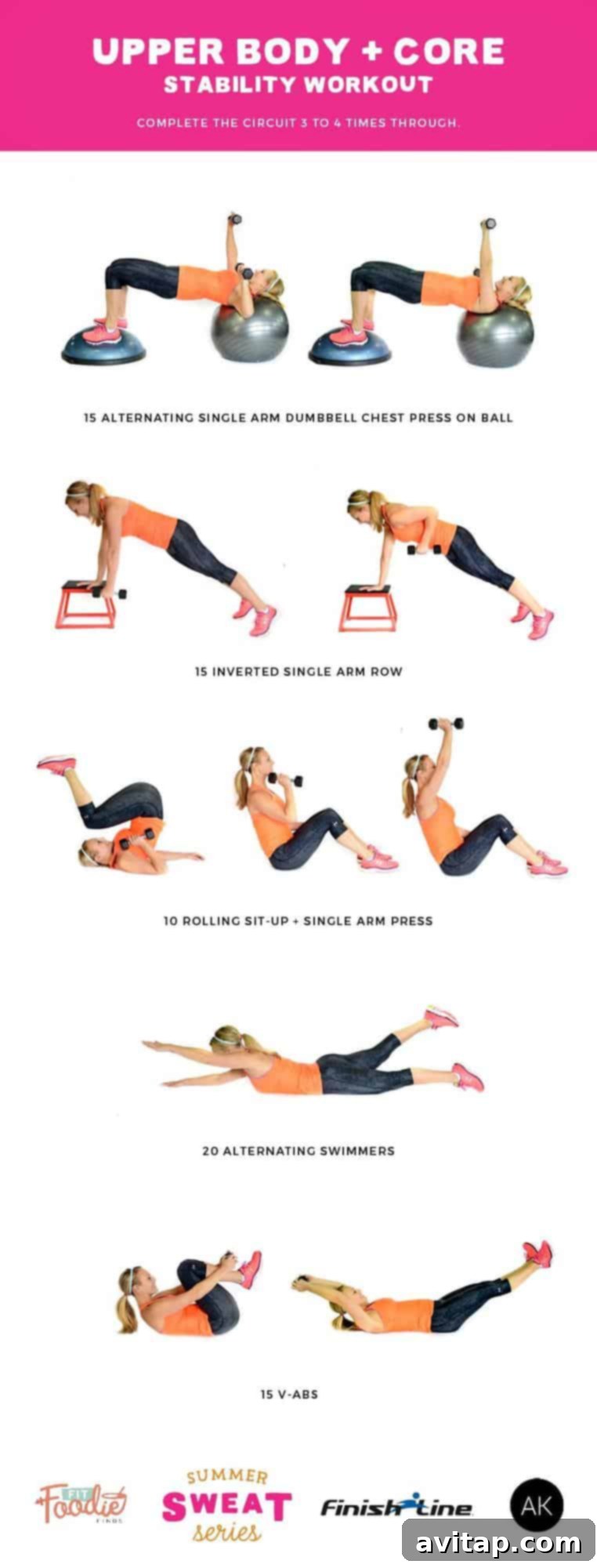
Workout Description: Complete the entire circuit 3 to 4 times through, depending on your fitness level and available time. Focus on controlled movements and proper form over speed. Remember, quality over quantity is key, especially when incorporating stability challenges.
Warm-Up: Prepare Your Body for Action (10-15 Minutes)
Never skip your warm-up! It’s crucial for preparing your muscles and cardiovascular system for the workout ahead, reducing the risk of injury, and improving performance. Start with light cardio to get your blood flowing, followed by dynamic stretches.
- 1 Mile Jog on the Treadmill or 10 Minutes on the Elliptical: This will gently elevate your heart rate, warm up your muscles, and increase blood flow throughout your body. Aim for a comfortable, conversational pace.
- Dynamic Stretches (2-3 minutes): Include arm circles (forward and backward), leg swings, torso twists, and cat-cow stretches to mobilize your joints and activate key muscle groups.
The Stability & Strength Circuit: Exercises Explained
1. Single Arm Dumbbell Chest Press on Ball (15 Reps per Side)
This exercise elevates the traditional chest press by introducing an unstable surface, intensely engaging your core and stabilizer muscles.
- Muscles Worked: Pectorals (chest), anterior deltoids (front shoulders), triceps, and a significant demand on the core and glutes for stability.
- Setup: Lie with your upper back and neck comfortably supported on a physio ball. Your feet should be placed on a bosu ball (dome side up for more challenge, flat side up for less). Your body should form a straight line from your knees to your head. Grab a medium-weight dumbbell in each hand, palms facing each other, arms extended straight above your chest.
- Execution: Keeping one arm extended and stable, slowly lower the other dumbbell out to your side, allowing your elbow to bend and descend until your upper arm is parallel to the floor, forming a “T” shape with your body. Feel the stretch in your chest. Maintain a strong, stable core to prevent your hips from rocking.
- Breathing: Inhale as you lower the dumbbell, exhale as you press it back up to the starting position.
- Form Tips: Keep your hips lifted throughout the entire movement, engaging your glutes. Avoid shrugging your shoulders. Your gaze should be directed straight up. Ensure your core is braced to maintain balance on the physio ball and bosu ball.
- Modification: To make it easier, place your feet on the floor instead of a bosu ball. To progress, use a heavier dumbbell while maintaining perfect form.
2. Inverted Single Arm Row (15 Reps per Side)
A challenging back exercise that also builds tremendous core strength and anti-rotational stability.
- Muscles Worked: Latissimus dorsi (lats), rhomboids, traps (upper and middle back), biceps, forearms, and deep core stabilizers.
- Setup: Begin in a high plank position with one hand planted firmly on a sturdy bench. Ensure your wrist is directly under your shoulder. Hold a medium to heavy-sized dumbbell in your other hand, letting it hang directly beneath your shoulder. Your body should form a straight line from head to heels, with feet hip-width apart.
- Execution: Keeping your hips absolutely parallel to the ground and your core tight, exhale and row the dumbbell upwards towards your chest. Drive your elbow towards the ceiling, squeezing your shoulder blade at the top of the movement. Avoid twisting your torso. The movement should primarily come from your back muscles.
- Breathing: Exhale as you pull the dumbbell up, inhale as you slowly lower it back down with control.
- Form Tips: The key here is to prevent any rotation in your hips and torso. Imagine you have a glass of water on your lower back that you don’t want to spill. Engage your glutes and core throughout. Control the lowering phase; don’t let the dumbbell just drop.
- Modification: Use a lighter dumbbell or perform the exercise with both hands on the bench, pulling your chest towards the bench (bodyweight inverted row) before progressing to a single-arm dumbbell row.
3. Rolling Sit-Up + Single Arm Press (10 Reps per Side)
This dynamic exercise combines core strength with upper body pressing power, improving coordination and fluidity of movement.
- Muscles Worked: Rectus abdominis, obliques, hip flexors, anterior deltoids, triceps, and serratus anterior.
- Setup: Begin seated on the ground with your knees bent and feet flat. Hold a medium-sized dumbbell in one hand, resting it near your shoulder (as if preparing for a shoulder press).
- Execution: Slowly roll onto your back, keeping your knees tucked into your chest and the dumbbell by your shoulder. Maintain control as you lower. Once your back is flat, immediately use your core strength to roll forward back to a seated position. As you reach the seated position, engage your core to keep your chest lifted and your back flat, then perform a single-arm overhead press with the dumbbell. Fully extend your arm without shrugging your shoulder.
- Breathing: Inhale as you roll back, exhale powerfully as you roll up and press the dumbbell overhead.
- Form Tips: Focus on a smooth, controlled roll rather than momentum. Keep your abdominal muscles engaged throughout. Avoid arching your back during the press; maintain a neutral spine. If the press causes discomfort, you can omit it and focus on the rolling sit-up.
- Modification: Use a lighter dumbbell or no weight for the press. Focus on the rolling sit-up motion first, ensuring smooth transitions before adding the press.
4. Alternating Swimmers (20 Total Reps)
A fantastic bodyweight exercise for strengthening the posterior chain, particularly the lower back and glutes, while improving spinal stability.
- Muscles Worked: Erector spinae (lower back), glutes, hamstrings, deltoids, and upper back stabilizers.
- Setup: Lie flat on your tummy with your legs extended straight behind you and your arms extended overhead, palms facing each other. Your forehead can rest lightly on the ground to maintain a neutral neck.
- Execution: On an inhale, simultaneously lift your chest slightly off the ground, along with your right arm and left leg. Keep your gaze towards the floor to maintain neck alignment. Hold for a moment, feeling the contraction in your lower back and glutes. Then, exhale and slowly release back to the starting position. Alternate sides, lifting your left arm and right leg in the next repetition.
- Breathing: Inhale as you lift, exhale as you lower.
- Form Tips: The movement should be controlled and deliberate, not a jerky lift. Focus on lengthening through your fingertips and toes. Avoid excessive arching of the lower back; the lift should come from glute and back engagement, not momentum. Keep your hips pressed into the floor as much as possible.
- Modification: Perform only the arm lifts or leg lifts separately before combining them. Reduce the range of motion if you feel any strain in your lower back.
5. V-Abs (15 Reps)
A dynamic and challenging core exercise that targets the entire abdominal region, promoting strength and definition.
- Muscles Worked: Rectus abdominis (especially lower abs), obliques, and hip flexors.
- Setup: Lie on your back holding 1 heavy dumbbell with both hands. Extend your arms overhead and your feet out long, so both are just a few inches off the ground. Create a slight “V” shape with your feet, keeping them together or slightly apart. Ensure your lower back is pressed into the floor.
- Execution: On the exhale, powerfully pull your knees into your chest while simultaneously pulling the dumbbell over your knees, reaching towards your shins or feet. Contract your abdominal muscles intensely at the peak of the movement. Your upper back will lift off the ground, but keep your neck relaxed.
- Breathing: Exhale forcefully as you crunch up, inhale as you slowly extend back to the starting position.
- Form Tips: Control the movement both up and down. Do not let your feet or dumbbell crash to the ground. Maintain tension in your core throughout. Focus on bringing your chest towards your knees. Keep your lower back pressed into the floor to protect your spine.
- Modification: Use a lighter or no weight. You can also modify by only bringing your knees towards your chest without lifting your upper body as much, or by doing regular crunches/leg raises separately. For progression, try to keep your legs straighter as you lift them.
Cool-Down: Stretch and Recover (5-10 Minutes)
After such an intense workout, a proper cool-down is essential for flexibility, reducing muscle soreness, and signaling to your body that it’s time to recover. Hold each stretch for 20-30 seconds, breathing deeply.
- Child’s Pose: Kneel on the floor, big toes touching, knees wide apart. Sit back on your heels, and walk your hands forward, resting your forehead on the mat.
- Cat-Cow Stretch: On hands and knees, arch your back on an inhale (cow) and round your spine on an exhale (cat).
- Pectoral Stretch: Stand in a doorway, place your forearms on the frame with elbows bent at 90 degrees. Step forward gently to feel a stretch across your chest.
- Triceps Stretch: Reach one arm overhead, bend the elbow, and let your hand fall behind your head. Use your other hand to gently push down on the elbow.
- Hamstring Stretch: Sit on the floor with one leg extended, the other bent with your foot towards your inner thigh. Reach for your extended foot.
- Hip Flexor Stretch: In a lunge position, gently push your hips forward, feeling the stretch in the front of the back leg.
Maximizing Your Results: Beyond the Workout
To truly unlock the full potential of this stability and strength workout, consider these additional tips:
- Consistency is Key: Aim to perform this workout 2-3 times per week, allowing for rest days in between. Regularity is more effective than sporadic intense sessions.
- Listen to Your Body: Pay attention to any pain or discomfort. Modify exercises as needed, and don’t hesitate to take an extra rest day if your body needs it. Progressive overload is important, but so is smart training.
- Fuel Your Body: Proper nutrition is vital for muscle repair and growth. Ensure you’re consuming enough protein, complex carbohydrates, and healthy fats. Stay well-hydrated throughout the day, especially around your workouts.
- Prioritize Sleep: Quality sleep is when your body repairs and recovers. Aim for 7-9 hours of sleep per night to support your fitness goals.
- Progress Gradually: As you get stronger, challenge yourself by increasing dumbbell weight, adding more repetitions, or completing an extra circuit. You can also explore more advanced variations of these exercises.
Embracing a lifestyle that supports your fitness efforts will accelerate your progress and help you achieve sustainable results. This workout is a fantastic step towards a stronger, more stable, and more confident you!
Disclaimer: Please consult your doctor or a qualified healthcare professional before starting any new fitness regime, especially if you have pre-existing health conditions or concerns. While the creators consulted with professional trainers for the Summer SWEAT Series fitness program, you are participating at your own risk. Always listen to your body and modify exercises as needed to ensure safety and effectiveness.
This post is sponsored by Finish Line as part of the Summer SWEAT Series. We were compensated for this content, and all opinions expressed are genuinely our own. Thank you for supporting Fit Foodie Finds and our partners who make content like this possible!