

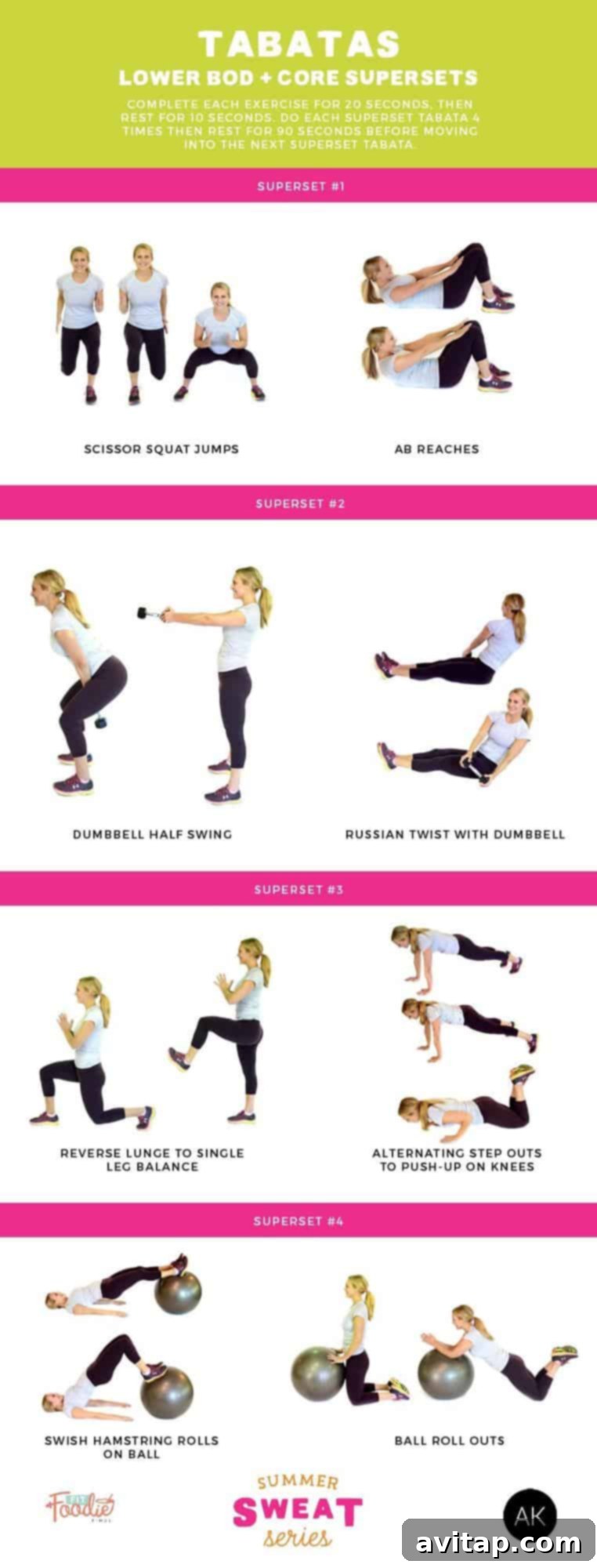
Ignite Your Fitness: Dynamic Tabata Workout with Lower Body & Core Supersets
Welcome to your ultimate high-intensity Tabata challenge! This meticulously designed workout regimen targets your lower body and core through powerful supersets, guaranteeing a full-body burn and significant improvements in strength, endurance, and fat loss. Whether you’re a seasoned athlete or looking to inject new energy into your fitness routine, this Tabata protocol offers a time-efficient and incredibly effective path to achieving your fitness goals. Prepare to push your limits, elevate your metabolism, and experience the transformative power of focused, intense training. Each exercise is explained in detail to ensure proper form and maximum benefit.
Unlocking the Power of Your Tabata Session
Equipment Needed: One Heavy Dumbbell (or Kettlebell), One Physio Ball (also known as an Exercise Ball)
Workout Description: This dynamic workout follows the renowned Tabata protocol, a specific form of high-intensity interval training (HIIT). You will perform each exercise for 20 seconds of maximum effort, followed by 10 seconds of complete rest. Within each superset, you will alternate between two exercises, completing four rounds of each. This means one full superset block consists of 8 rounds (4 for exercise A, 4 for exercise B, alternating), totaling 4 minutes of intense work. After successfully completing a 4-minute superset block, you will enjoy a well-deserved 90-second rest period before advancing to the next challenging superset Tabata. This precise structure is engineered to optimize your workout intensity, enhance cardiovascular health, and stimulate significant calorie expenditure and muscle development.
Prepare for Impact: The Essential Warm-Up Phase
Prior to engaging in any high-intensity exercise like Tabata, a thorough warm-up is non-negotiable. It prepares your muscles, joints, and cardiovascular system for the demands ahead, significantly reducing the risk of injury and enhancing your overall performance. Start with a light 1-mile jog on a treadmill to gradually increase your heart rate and blood flow, or opt for a dynamic warm-up routine focused on mobility and activation. Consider incorporating movements like leg swings, arm circles, torso twists, and dynamic stretches that mimic the exercises you’re about to perform. A great example is this recommended cardio warm-up routine, which ensures your body is primed and ready for intense work.
Superset #1: Explosive Power & Foundational Core Engagement
This introductory superset is designed to rapidly elevate your heart rate and activate your core muscles from the very start. It strategically pairs a plyometric lower-body exercise with a fundamental abdominal movement, ensuring a comprehensive and energetic beginning to your workout.
1. Scissor Squat Jumps: Begin in a standing position with your feet roughly hip-width apart, ensuring your body weight is evenly distributed. Initiate the movement with an explosive jump straight upwards. As you descend, land softly and immediately transition into a lunge position with your left foot forward, aiming for perfect 90-degree angles at both your front and back knees. Ensure your front knee is stacked directly over your ankle and your back knee hovers just above the ground. Without pause, launch back into another explosive jump, switching your leg positions mid-air to land with your right foot forward in the identical 90/90 lunge configuration. Following this, execute one final jump, landing gently back into your initial squat stance with feet hip-width apart, making sure your heels absorb the primary impact. This continuous, fluid exercise vigorously targets your quadriceps, hamstrings, glutes, and calves, while simultaneously boosting your cardiovascular endurance and developing explosive power. *Modification: For a lower-impact alternative, perform alternating reverse lunges without the jump, stepping back into the lunge and returning to standing before switching legs, focusing on controlled movement.
2. Ab Reaches: Lie comfortably on your back on a mat, bending your knees and firmly planting your feet flat on the ground, hip-width apart. Engage your abdominal muscles to gently lift your shoulders and upper back off the ground, maintaining a slight crunch throughout the exercise. Position your hands on your thighs, with your fingertips pointing towards your knees. With each controlled exhale, actively reach your hands forward, sliding them further up your thighs towards your knees. This action intensifies the contraction and engagement of your core musculature. Inhale as you slowly release back down, ensuring your shoulders do not fully touch the ground, thereby maintaining continuous tension. This precise and controlled movement primarily targets your rectus abdominis, effectively promoting core strength and definition. Emphasize slow, deliberate motions and synchronized breathing to maximize muscle activation and achieve optimal results.
Superset #2: Dynamic Strength & Oblique Carving
This formidable superset is engineered to combine a full-body, hip-driven power movement with an intense core rotation, building functional strength and meticulously sculpting your oblique muscles. Anticipate a significant increase in your heart rate, a substantial caloric burn, and enhanced overall muscle activation across your posterior chain and trunk.
1. Dumbbell Half Swing: Stand with your feet slightly wider than hip-width apart, holding a heavy dumbbell (or kettlebell) with both hands positioned between your legs. Initiate the movement by performing a powerful hip hinge: actively push your hips backward as if you are reaching for a wall behind you, maintaining a slight bend in your knees while keeping your chest proudly lifted. Crucially, remember this is a hinge, not a deep squat – your shins should remain relatively vertical. As the dumbbell naturally swings back between your legs, drive your weight into your heels and explosively thrust your hips forward. This powerful hip drive will propel the dumbbell upward to approximately eye level. Ensure your arms remain straight and extended throughout the swing, and actively prevent any hyperextension in your lower back at the top of the movement. The primary power for this exercise originates almost entirely from your glutes and hamstrings, with your core providing essential stability for your spine. This exercise is exceptionally effective for developing robust posterior chain strength and explosive power.
2. Russian Twist with Dumbbell: Sit on the floor with your knees bent. For an advanced challenge, lift your feet off the ground; for a modification, keep them firmly planted. Lean back slightly, maintaining a straight back and engaged core. Hold the dumbbell firmly with both hands, extending your arms straight out in front of you. Keeping your chest lifted and your back flat (actively avoid slouching), twist your torso to the right, bringing the dumbbell towards the floor beside your hip. Feel the deep engagement in your oblique muscles. Immediately and fluidly, twist to the left, replicating the motion on the opposite side. Exhale forcefully with each twist, further intensifying the contraction of your oblique muscles. This exercise is paramount for developing rotational core strength, improving overall trunk stability, and defining your waistline. *Modification: Perform this exercise without a dumbbell, or keep your feet planted firmly on the ground for increased stability and focus on core engagement.
Superset #3: Integrated Balance, Strength & Upper Body Push
This thoughtfully constructed superset challenges your proprioception and balance, systematically targets lower body strength, and integrates a vital upper body pushing movement. This combination ensures a well-rounded and functionally challenging segment within your overall fitness routine, promoting stability and synergistic muscle activation.
1. Alternating Reverse Lunge to Single Leg Balance: Begin standing tall with your feet positioned hip-width apart, maintaining an engaged and alert posture. Take a controlled step backward with your right leg, gracefully lowering yourself into a deep reverse lunge. Ensure your front knee remains perfectly stacked directly over your ankle, and your chest stays proudly lifted and open. From this lunge position, powerfully drive through your left heel and, in a coordinated motion, simultaneously bring your right knee forward and up towards your chest, balancing firmly on your left leg. Hold this single-leg balance momentarily, actively engaging your core and glutes for stability. Slowly and with precise control, reset your right foot back to the starting standing position. Then, seamlessly repeat the entire sequence, this time stepping back with your left leg. This exercise significantly enhances balance, fortifies your quadriceps, hamstrings, and glutes, and sharpens your proprioception. *Advancement: Incorporate light to medium-weight dumbbells, holding them at your sides, to add external resistance. This intensifies the challenge to your lower body muscles and core stabilizers.
2. Alternating Step Outs to Push-Up on Knees: Adopt a strong high plank position, ensuring your shoulders are stacked directly over your wrists, your core is tightly engaged, and your back forms a perfectly flat line from the crown of your head to your heels. From this stable plank, lightly tap your right toe out to the side, then smoothly return it to the starting plank position. Immediately follow by tapping your left toe out to the side and bringing it back. After completing both toe taps, gently lower yourself onto your knees (crucially, maintaining core engagement throughout this transition) and perform a modified push-up. Focus intently on leading with your chest, keeping your elbows tracking closely towards your body, and maintaining a flat back throughout the entire push-up motion. Push back up to the knee-plank position, then return to the high plank to repeat the entire sequence. This exercise skillfully integrates core stability, dynamic lower body movement, and upper body pushing strength, providing a comprehensive challenge. *Advancement: Perform push-ups directly on your toes, maintaining a full plank position throughout the entire movement for a significantly increased challenge to your upper body and core.
Superset #4: Hamstring Power & Advanced Core Stability with Physio Ball
The final superset in this Tabata sequence is strategically designed to isolate and intensely strengthen your hamstrings, a muscle group often underutilized. Simultaneously, it will push your core stability to its absolute maximum by leveraging the unstable nature of the physio ball. This demanding segment requires precise control, unwavering focus, and significant strength from your posterior chain and deep core muscles.
1. Swiss Hamstring Rolls on Ball: Lie flat on your back on a mat with your legs fully extended. Place your calves and heels firmly on top of a physio ball. Engage your glutes and core deeply to lift your hips off the ground, aiming to create a straight, rigid line from your shoulders through your hips to your knees. This elevated position serves as your starting point. As you inhale, slowly and with deliberate control, roll the ball towards your body by bending your knees, bringing your heels closer to your glutes. As the ball moves inward, actively lift your hips even higher towards the ceiling, maximizing the contraction in your hamstrings and glutes. On the exhale, slowly extend your legs, rolling the ball back to the starting position while steadfastly maintaining that elevated hip line. This exercise is exceptionally effective for hamstring development, glute activation, and demanding core stability. Focus on smooth, deliberate movements to prevent any momentum-driven swinging and ensure pure muscle engagement.
2. Ball Roll Outs: Kneel on a mat with your knees positioned hip-width apart. Place your hands firmly on top of the physio ball, directly beneath your shoulders. Engage your core muscles intensely, striving to maintain a perfectly straight line from your head down through your hips to your knees. On an inhale, slowly and with control, roll the ball forward, extending your arms and allowing your body to lower towards the floor. Only go as far as you can maintain that perfectly straight line with your back, actively preventing any arching or sagging in your lower back. Feel the profound engagement in your abdominal muscles (rectus abdominis and transverse abdominis) and your lats as you reach your maximum controlled extension. On the exhale, powerfully engage your core to pull the ball back towards your body, returning to the starting kneeling position. This advanced core exercise comprehensively targets the entire anterior core, building incredible strength and resilience. *Advancement: For an extreme challenge, perform roll-outs from a standing position on your toes, requiring even greater core strength and meticulous control. *Modification: If a full roll-out proves too challenging, focus on holding a perfect high plank position for the duration of the interval, or perform shorter, more controlled rolls without reaching full extension.
Maximize Your Results: The Varsity Challenge!
Feeling exceptionally strong and ready to push your boundaries further? For the ultimate test of endurance, strength, and mental fortitude, challenge yourself by completing this entire Tabata circuit one more time! This “Varsity” challenge will significantly amplify your metabolic rate, further solidify your fitness gains, and prove your unwavering commitment. Throughout this extended challenge, prioritize maintaining impeccable form and always listen closely to your body’s signals, taking brief, necessary breaks if your form begins to falter.
Cool Down: Essential for Optimal Recovery & Flexibility
Following such an intense and demanding workout, a proper cool-down is absolutely paramount for facilitating muscle recovery, enhancing flexibility, and gradually bringing your heart rate back to its resting state. Dedicate a crucial 5-10 minutes to performing static stretches, holding each stretch for a comfortable duration of 20-30 seconds. Concentrate on thoroughly stretching the major muscle groups that have been actively engaged during your Tabata session: target your hamstrings (e.g., a seated forward fold), quadriceps (e.g., a standing quad stretch), glutes (e.g., a figure-four stretch), and core (e.g., gentle cat-cow stretches or a relaxing child’s pose). Incorporating deep, controlled breathing throughout your cool-down will also significantly aid in relaxation, mental unwinding, and the overall recovery process.
Disclaimer: Always consult with your doctor or a qualified healthcare professional before embarking on any new fitness regimen, especially one of high intensity. While this comprehensive workout program has been meticulously developed with valuable insights from professional trainers, your decision to participate is entirely at your own risk. It is critically important to listen attentively to your body’s signals, modify exercises as needed to suit your current fitness level and physical limitations, and always prioritize correct form over speed or intensity to effectively prevent injuries and ensure a safe, effective workout experience.